Can You Ride A Bike On The Sidewalk In Toronto?
The short answer on sidewalk cycling in Toronto, the Ontario rules behind it, where kids fit in, and how to ride downtown streets with confidence.
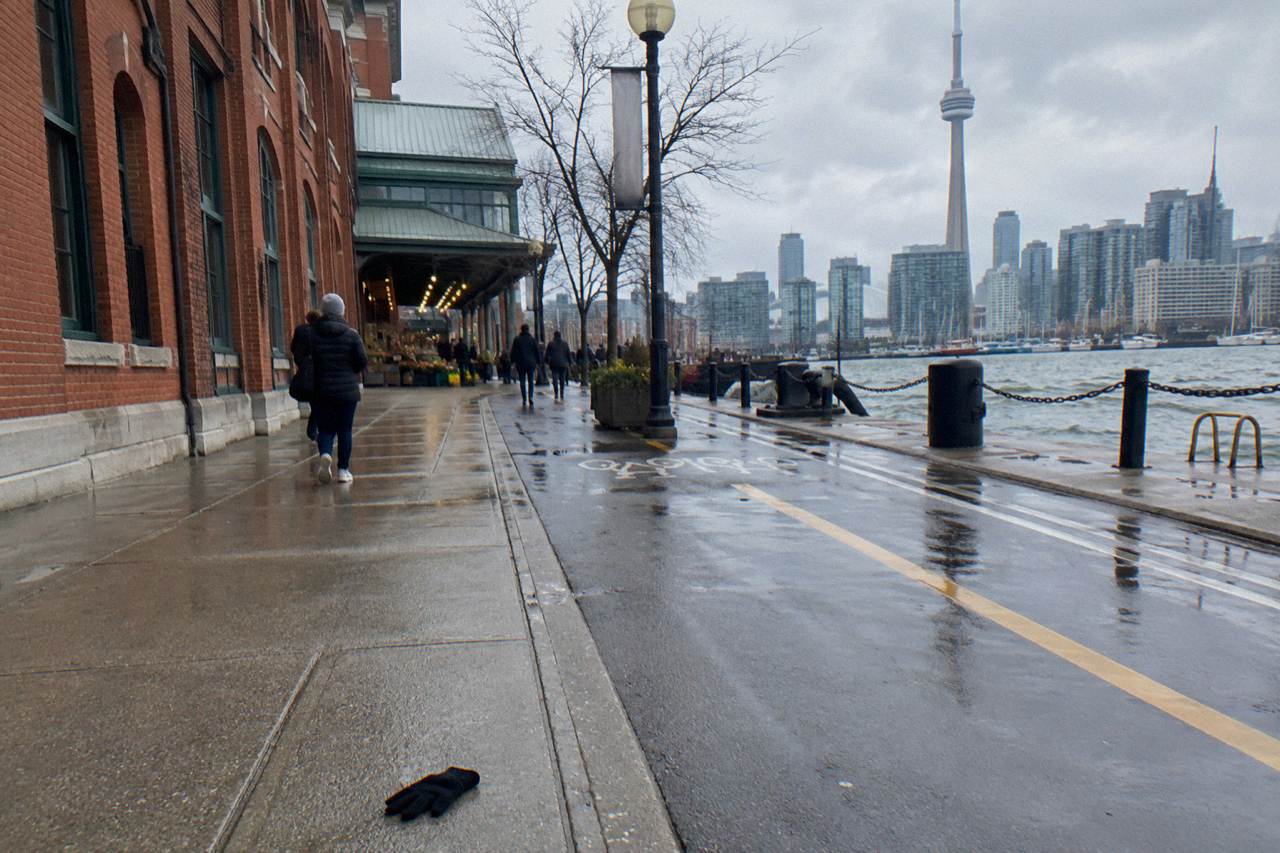
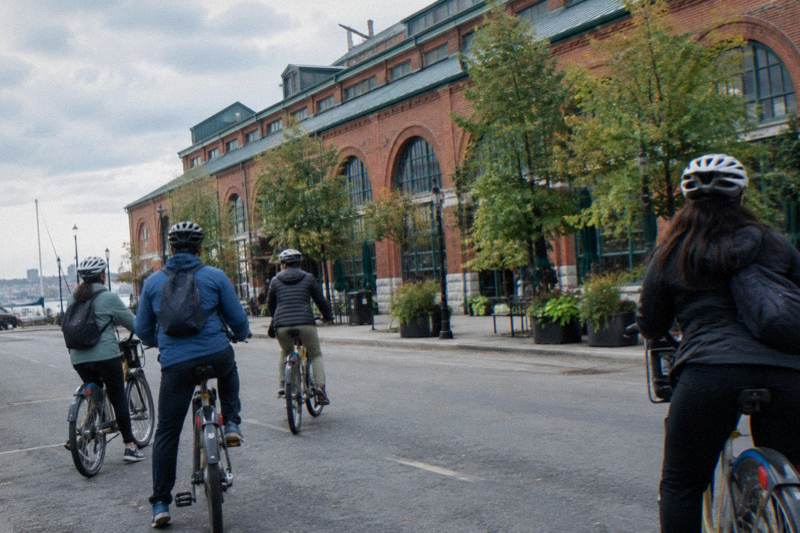
No, riding a bicycle on sidewalks is not allowed in Toronto. Ontario's bicycle safety rules state it plainly, and the city follows the provincial law. The single exception is age based: children under 10 can ride on the sidewalk. Every other rider, visitor or local, is expected to use the road, a bike lane, or a multi-use trail. And if you're wondering about head protection while you ride, our guide on helmet rules for Toronto cyclists explains who actually has to wear one.
That one sentence settles the legal question, but it rarely settles the practical one. Visitors arrive in Toronto, see eight lanes of traffic on University Avenue, watch a streetcar track disappear under a car door zone, and feel their confidence evaporate. The sidewalk starts to look reasonable. It is not, and this article explains why the rule exists the way it does, what the one exception actually covers, and what a rider who is nervous about Toronto streets can do instead of hopping a curb.
The rule is provincial, which matters for how you should read it. Ontario's official bicycle safety page is the source for the sidewalk restriction and the child exception alike. Toronto does not add a separate, more lenient sidewalk policy on top of it. When in doubt, the Ontario page is the document to check, because it is the level of government that wrote the rule.
There is also a gentler way to learn the city than trial and error. A guided ride such as the Heart of Downtown guided ride puts a local guide at the front of a small group, which is one of the fastest ways to see how Torontonians actually handle busy intersections. More on that later.
What The Ontario Rules Actually Say
Ontario's bicycle safety rules prohibit riding a bicycle on sidewalks, with an exception for children under 10. The same provincial page sets out required equipment: a bell or horn, a white front light, a red rear light or reflector at night, and reflective tape on the forks. Riders under 18 must wear an approved helmet. Toronto applies these provincial rules rather than replacing them.
Start with the sidewalk line itself, because it is narrower than many visitors assume. The Ontario page frames sidewalk riding as not allowed, full stop, for riders who are not young children. There is no "quiet residential street" carve-out, no "only when the bike lane is blocked" clause, and no visitor exemption. The rule does not distinguish between a deserted Sunday-morning sidewalk in Scarborough and a crowded Saturday sidewalk on Queen Street West.
No fine amount is verified in the sources behind this article, so none is printed here. If you want the current penalty figures, the Ontario page is the authority to consult, since it is the level of government that owns the rule. Toronto-specific bylaw wording is likewise not verified here, and it is safer to treat the provincial page as the reference point than to rely on secondhand summaries that quote numbers nobody can source.
The equipment list travels with the sidewalk rule, and it is worth knowing even for a short ride.
| Requirement | Ontario rule | When it applies |
|---|---|---|
| Helmet | Approved bicycle helmet, mandatory | Riders under 18 |
| Bell or horn | Required on the bicycle | At all times |
| Front light | White | Night riding |
| Rear light or reflector | Red | Night riding |
| Reflective tape | On the forks | Night riding |
The logic connecting these rules is visibility and predictability. A bicycle on a sidewalk is invisible to drivers checking for pedestrians at driveways and turning across intersections; the collisions that result are exactly the kind the sidewalk rider was trying to avoid. Keeping bikes on the road, lit and audible, keeps them inside the sightlines drivers are already scanning.
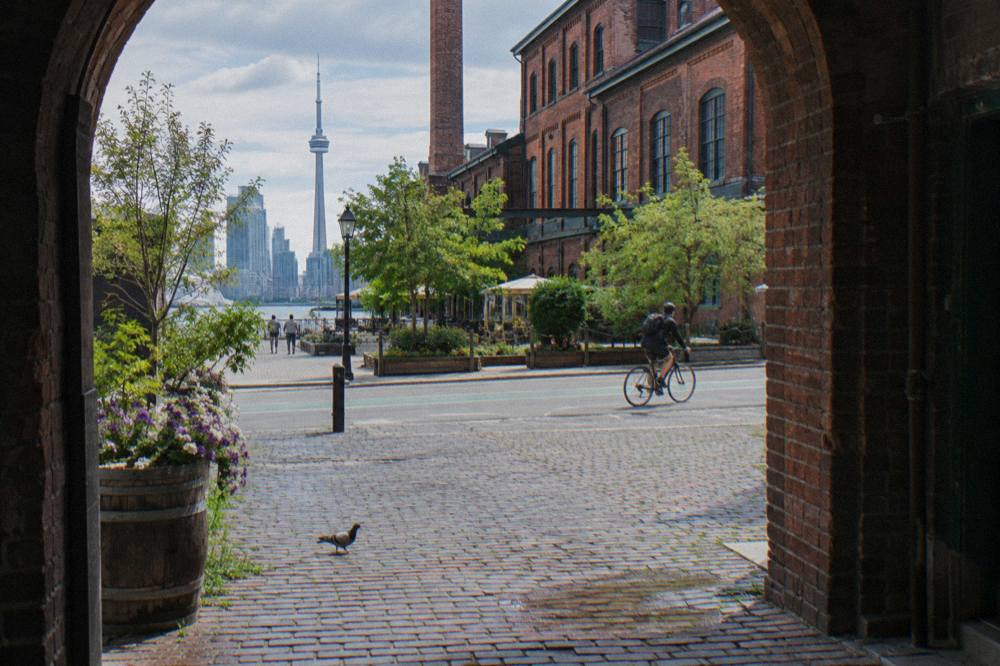
This is also where e-bike riders should pause. Ontario treats e-bikes as their own category: the rider must be 16 or older, must wear an approved helmet, and the motor can assist only up to 32 km/h with a maximum weight of 120 kg and a motor not exceeding 500 watts, per the province's e-bike rules. A powered bike on a sidewalk combines speed with invisibility, which is the worst pairing on the list, and the sidewalk prohibition applies to it as surely as to a pedal bike.
Where Children Fit In
Children under 10 can ride on the sidewalk in Toronto. That is the exception written into the Ontario rules, and it exists because a small child pedalling at walking pace among buses and delivery trucks is at more risk on the road than beside pedestrians. There is no verified guidance on accompanying adults riding alongside on the sidewalk; the equipment and helmet rules for under-18 riders still apply.
Draw the line carefully. The exception is for the child on the bicycle, not for a parent riding escort on the same sidewalk. An adult rolling beside a nine-year-old is still an adult on a sidewalk, and the sensible reading of the provincial page is that the adult should be on the road, walking pace if needed, or off the bike entirely. Family riding in Toronto works best on the multi-use trails, where everyone belongs regardless of age.
That points to the real answer for families: route choice. Toronto's trail network is enormous, and the December 2025 network count, published by the city's cycling network status page, gives the scale of it.
| Facility type | Length in Toronto (December 2025) |
|---|---|
| Cycle tracks | 110.1 km |
| Bicycle lanes | 143.8 km |
| Sharrows | 92.1 km |
| Multi-use trails | 399.3 km |
The 399.3 km of multi-use trail means a family with a seven-year-old and a twelve-year-old does not have to choose between a road neither can handle and a sidewalk only one of them may legally use. The Martin Goodman Trail alone runs more than 20 km along the waterfront from the western to the eastern beaches, car-free for its entire length. It is the single best family cycling asset in the city, and it removes the sidewalk question entirely.
For a child on a sidewalk, the helmet rule still applies, because it applies to every rider under 18 on any surface. A bell, oddly enough, earns its keep on the sidewalk more than anywhere: a polite ding before passing a pedestrian is the difference between a courteous pass and a startled one.
Why Toronto Sidewalks Tempt Cyclists Anyway
Sidewalk riding in Toronto is usually a confidence problem wearing a legal costume. Riders who feel unsafe mixing with traffic, or who hit a stretch where a bike lane suddenly ends or is blocked by construction or a parked truck, pop onto the sidewalk out of fear rather than convenience. The fix is route knowledge and riding experience, not the curb.
The infrastructure news of 2026 explains part of the nerves. Ontario completed removing the protected bike lanes on a 1.2 km stretch of Bloor Street West in Etobicoke on 30 October 2026, the first removal under the province's plan, restoring motor vehicle lanes in both directions. An Ontario Court of Appeal ruling on 14 August 2026 had upheld the province's authority to do so, and advocates announced in October they would seek leave to appeal to the Supreme Court of Canada. A provincial request for proposals, issued 1 September 2026, covers options for roughly 19 km of Bloor, Yonge, University, Queen's Park and Avenue Road. The wider set of guides lives on Bike Tours Toronto.
Riders do not follow court dockets; they follow their eyes. When a protected lane they relied on disappears, the instinct is upward, onto the sidewalk. Closer to the waterfront, the Martin Goodman Trail on Parliament Street has been closed from 22 April to 31 December 2026, with a temporary two-way protected lane carrying cyclists during Queens Quay East construction. Detours like this one are signed, and following them beats improvising onto a sidewalk every time.
The other driver of sidewalk temptation is simple inexperience. A visitor who has never ridden in a North American downtown meets a turning garbage truck at Bay and Dundas and concludes, reasonably, that the road is for other people. The conclusion is wrong, but the feeling is honest. What that rider needs is not a lecture, it is a few hours of guided riding in a group, after which busy intersections read as normal rather than hostile.
Weather plays its part too, mostly by shrinking patience. November's average high in Toronto is 8.1 C with about 70.8 mm of precipitation over roughly nine days with 1 mm or more, per the Environment Canada 1991 to 2020 normals for Toronto City. A cold, wet rider cuts corners. The rules do not bend for discomfort, so the planning answer is dressing for the normals rather than hoping for the exception.
How To Ride Downtown Streets Legally
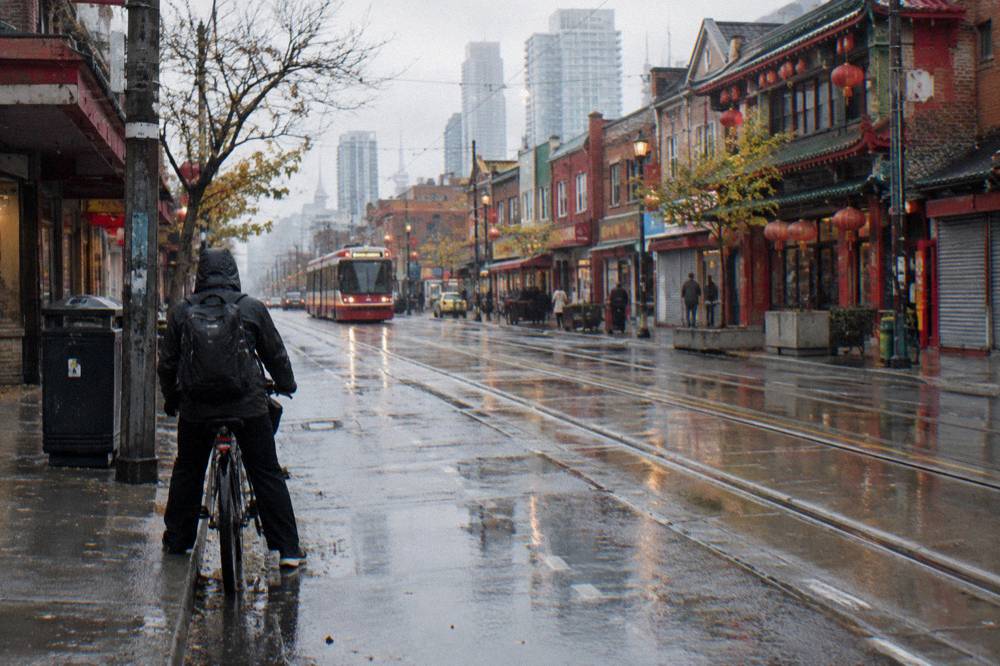
Riding legally downtown means taking the bike lane where one exists, taking the lane where one does not, and treating every parked car as a possible door. The core habits are riding far enough from parked cars to avoid an opening door, positioning yourself visibly at intersections, and never passing a streetcar on its right when its doors are loading. None of this requires speed; it requires position.
The door zone is the first lesson. A bike lane sandwiched between moving traffic and parked cars is only as safe as the distance you keep from the parked side. Riders who hug the parked cars to feel protected from traffic are trading one hazard for a worse one, because a door opens faster than anyone can react. Taking a metre of space from the parked row is legal positioning, not aggression.
Intersections are the second lesson. The majority of car-bike collisions in cities happen where paths cross, not mid-block, which is exactly why sidewalk riding fails as a safety strategy: every driveway and every corner becomes a crossing, and drivers are not looking for a vehicle moving at cycling speed on a pedestrian surface. On the road, you are inside the traffic pattern drivers expect, and that expectation is your armour.
The third lesson is route selection, and it is where the network numbers earn their keep. The 399.3 km of multi-use trail and 110.1 km of cycle track are not evenly spread, but downtown and the waterfront are well served, and a rider who plans a route along the trail spine rather than the fastest arterial street can cross most of the centre city with very little mixed traffic. Our Toronto bike lanes and path map guide lays out the detail, and the cycling in Toronto as a visitor guide covers the basics for first-timers.
This is precisely the territory the related tour for this article was built for. The Heart of Downtown Ride is a 3.5-hour guided bicycle tour with snacks included, listed in the downtown neighbourhoods category, and its whole premise is a guide leading a shared group through the downtown streets where a nervous rider would otherwise be tempted by the sidewalk. Pricing and current availability are on the booking page rather than quoted here. Three and a half hours of following a guide through real intersections does more for street confidence than any amount of reading, because the habits become muscle memory instead of theory.
Sidewalk Situations Riders Ask About
The questions come in a handful of familiar shapes: crossing a driveway, riding the last block to a shop, sharing a trail that looks like a sidewalk, and walking the bike. Crossing is fine while riding along a road, walking the bike on a sidewalk is always fine because a walked bike is a pedestrian, and shared-use paths are not sidewalks even when paved the same way. The distance question is where people slip.
Take them one at a time. A rider on the road who crosses a driveway or a minor side street is still riding legally; the prohibition targets sustained riding along the sidewalk, not the momentary crossing every road rider performs dozens of times a trip. A rider who dismounts and walks the bike on a sidewalk has left the rule entirely, because a walked bicycle is not being ridden, and this is the correct way to cover the final half block to a café door.
Shared-use paths cause honest confusion. A paved path through a waterfront park is not a sidewalk even when the surface looks identical, and the multi-use trail category in the network count exists precisely for this. The tell is signage and context: a path inside a park or along the waterfront is a trail, a strip beside a road through a commercial strip is a sidewalk. When signage is ambiguous, the safe default is pedestrian speed or dismounting.
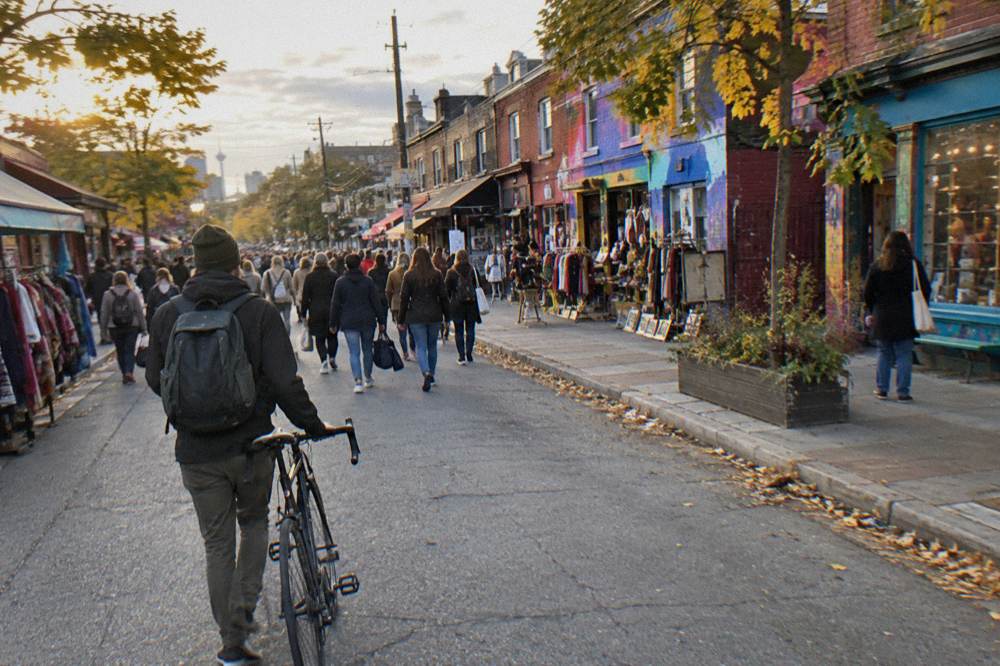
The temptation is strongest, and the rule matters most, exactly where visitors concentrate: downtown. Kensington Market and its pedestrian Sundays, the Distillery District, the blocks around St. Lawrence Market, these are dense, interesting, and full of people stepping out of doorways. On the last Sunday of each month from May through October, parts of Kensington Market go car-free for Pedestrian Sundays, noon to 7 p.m., which is a lawful and joyful place to ride slowly, or better, to walk the bike through the crowd.
If You Want Confidence, Ride With A Guide First
Guided rides solve the sidewalk problem indirectly, by removing the fear that causes it. A guide who rides at the front of a group chooses the lane, sets the pace, calls out hazards, and demonstrates intersection positioning in real time. For a visitor, one guided morning typically replaces a week of anxious solo trial rides, and it is the difference between experiencing Toronto's street grid and merely surviving it.
The options on this site span the two halves of the city a visitor most wants. The downtown rides cover the neighbourhoods where sidewalk temptation peaks: the financial district's wide arterials, Kensington, the Distillery, Chinatown. The waterfront and islands rides take the car-free route instead, crossing to Toronto Island Park where the only vehicles are emergency and commercial, which makes them the natural choice for riders whose confidence is still building.
Consider the Waterfront and Islands guided ride, a 3.5-hour classic bicycle tour in the islands category, as the confidence-builder: it spends its kilometres on trail and island roads rather than mixed traffic, so a newer rider finishes with miles in the legs and none of the stress. The Downtown Toronto Bike Tour, 3 hours 30 minutes and also classic bike with snacks, is the same operator product family listed separately, and downtown riders can pick either listing depending on where they prefer to book; the experience on the street is the shared-group downtown ride either way.
One practical note on booking: pricing, meeting points and inclusions for each ride are stated on the booking page, and free-cancellation terms, where offered, are listed there too. Reading the meeting point before the day of the ride saves the classic mistake of starting a downtown ride already flustered.
After a guided ride or two, most riders find the sidewalk holds no appeal at all. The road makes sense once someone has shown you how it works, and Toronto's trail spine handles the rest. Ride the road or the trail, walk the bike when the crowd wins, and keep the sidewalk for the people it was built for.
Common Questions About Sidewalk Cycling In Toronto
Can You Ride A Bike On The Sidewalk In Toronto?
No. Ontario's bicycle safety rules state that riding a bicycle on sidewalks is not allowed, and Toronto follows the provincial rule. The only exception is children under 10, who can ride on the sidewalk.
Can Children Ride Bikes On Toronto Sidewalks?
Yes, children under 10 can ride on the sidewalk under the Ontario rules. An adult riding alongside them is still subject to the sidewalk prohibition, so escorting on foot or from the road is the compliant approach.
What Equipment Does Ontario Require On A Bicycle?
A bell or horn at all times, a white front light and a red rear light or reflector at night, and reflective tape on the forks for night riding. Riders under 18 must wear an approved bicycle helmet.
Can You Walk Your Bike On A Sidewalk In Toronto?
Yes. A walked bicycle is not being ridden, so the sidewalk prohibition does not apply. Walking the bike for the final block to a destination, or through a dense crowd, is the correct move.
Where Should A Nervous Rider Cycle In Toronto Instead?
Multi-use trails are the safest starting ground, with 399.3 km across the city as of December 2025, including the Martin Goodman Trail's more than 20 km along the waterfront. A guided downtown ride is the fastest way to build comfort on streets.