E-Bike Or Regular Bike On A Toronto Tour?
Toronto is mostly flat, but the lake wind, the bridge to the Islands and the length of a guided ride all shape whether an e-bike or a regular bike suits your day.
Short answer
Toronto has two e-bike guided rides and a set of regular-bike rides, all around 3.5 hours. Ontario law requires e-bike riders to be 16 or older, helmeted, and capped at 32 km/h assisted speed. E-bikes over about 40 kg may be sent to the vehicle ferry. Prices and inclusions are on each booking page.
Toronto is one of the flatter big cities you will ever pedal, and that flatness fools people into booking the wrong bike. The streets climb gently away from the lake, the wind off Lake Ontario pushes back hard in one direction, and a guided ride that lists 3.5 hours is a long stretch for anyone who has not sat on a saddle recently. The choice between an e-bike and a regular bike on a Toronto tour is less about hills and more about wind, distance and how tired you want to be at the halfway mark.
The practical difference is small in kilometres and large in feel. Both bike types appear across the guided options here: two e-bike rides through the city's neighbourhoods, and a wider set of regular-bike rides covering downtown, the waterfront and the Islands. This guide compares them on fitness, terrain, law, ferries, batteries and price structure, using the listing details and verified Ontario rules. Where a figure is not published, the honest answer is to check the booking page rather than guess.
Is An E-Bike Easier Than A Regular Bike In Toronto?
Yes, in the specific ways Toronto is hard: the lake headwind, the gentle climbs away from the water, and the sheer length of a 3.5-hour guided ride. Toronto is not a hilly city, so an e-bike is not buying you climbs so much as buying you endurance, comfort and the ability to finish the ride and still enjoy your evening. The motor also matters on bridges, including the crossing to the Islands if your route includes it.
Start with terrain. The city's cycling network, as of December 2025, counted 346 km of on-street cycling infrastructure plus 399.3 km of multi-use trails, and the overwhelming majority of it sits on near-level ground near the lake. Nobody needs a motor for gradient here. What the motor actually fights is the wind: air moving off Lake Ontario is a constant factor on the waterfront and on the Islands, and it rarely blows in both directions at once. Riders coming back east along the lake into a westerly wind describe the last stretch as the hardest part of an otherwise easy day. On an e-bike, that stretch disappears.
The second factor is duration. Every guided ride in the current options lists about 3.5 hours, which is a genuine half-day of pedalling for a casual rider. On a regular bike that means roughly three hours of continuous effort with snack stops. On an e-bike it means three hours of light assistance with the same stops. If you ride weekly, the regular bike is pleasant. If you ride once a season, or you are booking as a pair with mixed fitness levels, the e-bike closes the gap between the fastest and slowest rider, which is the quiet reason mixed groups end up enjoying e-bike tours more. If a mixed group has you leaning toward a private outing instead, the guide to booking a private guided bike ride in Toronto covers who private rides suit and what to ask before you commit.
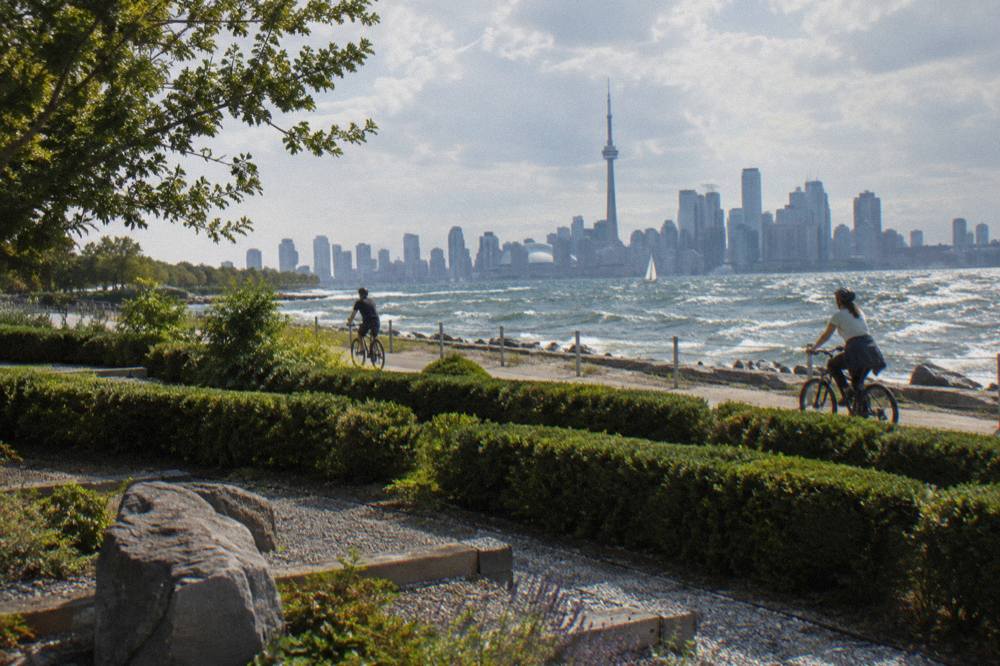
There is also a confidence factor that has nothing to do with fitness. Some riders feel safer with the ability to accelerate away from a stop and keep pace with traffic on shared streets. Ontario caps assisted speed at 32 km/h, which is comfortably above the pace of a guided tour group on city streets, so the motor is a reserve rather than a throttle race.
Which Toronto Tours Offer E-Bikes And Which Offer Regular Bikes?
Two guided rides list e-bikes: E-bike through Toronto's Dynamic Neighbourhoods and its twin listing, E-bike Toronto's Dynamic Neighbourhoods. Everything else on offer, including the Heart of Downtown ride and all the Islands and waterfront rides, uses regular bikes. All of them run about 3.5 hours. So the bike type, not the duration, is the real fork in the decision.
The comparison below comes from the listing details for each option. Note that the two e-bike listings are separate listings of the same operator product, offered on different booking pages, so treat any price difference as a listing difference rather than a better deal.
| Tour | Bike type | Duration | Category |
|---|---|---|---|
| E-bike through Toronto's Dynamic Neighbourhoods | E-bike | 3.5 hours | Neighbourhoods |
| E-bike Toronto's Dynamic Neighbourhoods | E-bike | 3 hours 30 minutes | Neighbourhoods |
| Toronto: Heart of Downtown 3.5-Hour Bike Tour | Regular bike | 3.5 hours | Downtown |
| Downtown Toronto Bike Tour | Regular bike | 3 hours 30 minutes | Downtown |
| Toronto Waterfront and Islands Guided Bicycle Tour | Regular bike | 3.5 hours | Waterfront and Islands |
| Toronto Islands: Morning or Twilight 3.5-Hour Bike Tour | Regular bike | 3.5 hours | Islands |
| Toronto Islands: Sunrise Breakfast Bicycle Tour | Regular bike | 3.5 hours | Islands |
| Islands Morning, Evening and Waterfront variants | Regular bike | about 3.5 hours | Islands and waterfront |
The pattern is blunt: if you want a motor, the neighbourhoods ride is your option. If you want the Islands, the waterfront or the Distillery District, you are on a regular bike, and the flat island roads make that a reasonable design choice rather than a limitation.
Both e-bike listings carry very few reviews at this point, two for one of them, which is far too thin a pool to support any rating claim. Treat them as promising but unproven rather than reaching for a substitute verdict. The regular-bike rides have their own review histories on their booking pages; check the current numbers there before deciding what the crowd thinks.
Beyond those, there is a wider set of Toronto Islands bike tours if the island loop is what drew you to the idea of a guided ride in the first place.
Do You Need A Licence Or Helmet For An E-Bike Tour In Toronto?
No licence is needed, but Ontario e-bike law sets firm requirements: the rider must be 16 or older and must wear an approved bicycle or motorcycle helmet. The motor may not exceed 500 watts, the bike may not weigh more than 120 kg, and assisted speed is capped at 32 km/h. Tours supply the bike, so your obligations are age, helmet and sense.
These rules come straight from the province's e-bike page, and they apply on tour the same as anywhere else. The age floor matters for families: a rider under 16 cannot legally take the e-bike option, so a family booking with teenagers should plan around the regular-bike rides. The province spells out the full requirements on its official e-bike rules page.
For riders under 18 on regular bikes, a helmet is also mandatory by law, and Ontario requires working brakes, a bell or horn, and lights or reflectors after dark. Tour operators supply maintained bikes, so equipment compliance is their job, but the helmet on your head is the law you personally answer for.
| Requirement | Regular bike | E-bike |
|---|---|---|
| Minimum rider age | No provincial minimum | 16 or older |
| Helmet | Mandatory under 18 | Mandatory for all riders |
| Maximum assisted speed | Not applicable | 32 km/h |
| Motor limit | Not applicable | 500 watts |
| Weight cap | Not applicable | 120 kg |
| Licence or registration | Not needed | Not needed |
One Toronto-specific wrinkle: riding on sidewalks is not allowed, with an exception for children under 10. E-bike or not, the tour stays on streets, paths and trails.
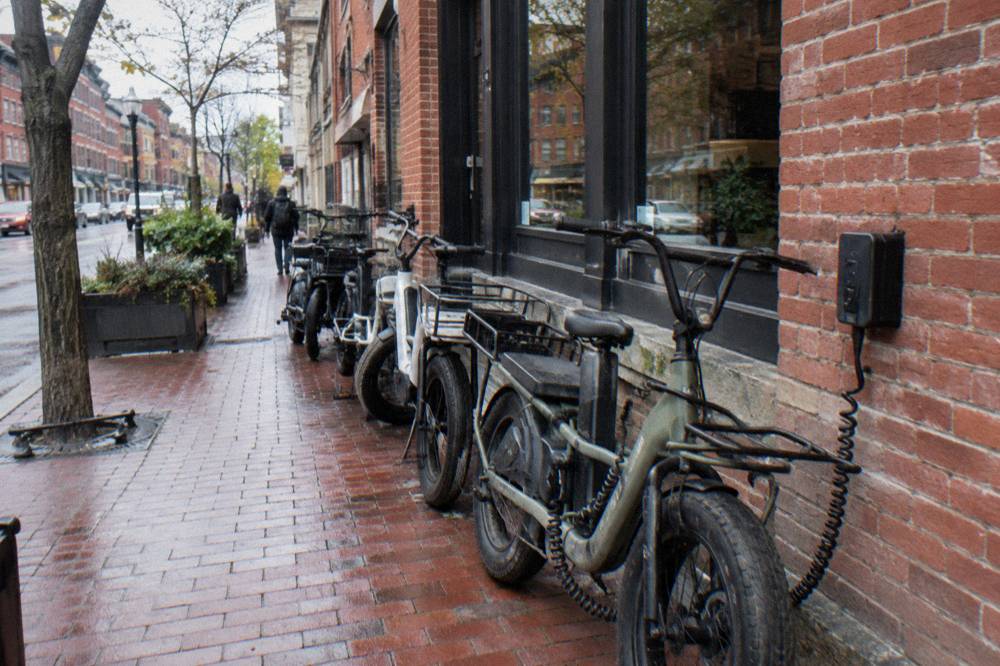
Can you take an e-bike on the ferry to the Islands? Yes, with conditions. Bicycles are welcome on the ferries and riders walk them on and off, but Bike Share bicycles are not permitted. E-bikes are welcome at the discretion of staff, must stay fully powered off on board, cannot be charged on the ferry or at the terminal, and larger e-bikes, roughly 40 kg and over, may be directed to the vehicle ferry. The City's ferry ticketing page carries the current wording. Since the guided island rides use regular bikes, this mostly matters if you are renting an e-bike independently; the full picture is in our guide to the ferry with a bike.
How Much Does The Battery Matter On A Guided Ride?
Less than you fear, more than you might assume. A 3.5-hour guided tour moves at conversation pace with stops, so the battery is not stretched by distance. The variables are the assistance level you choose, the wind, rider weight and how much climbing the route includes. Tour operators report carrying bikes suited to their routes, and charging is not possible on the ferry or at the terminal.
Toronto's near-flat geography keeps draw low. The motor works hardest on starts, on the rises away from the lake, and against a stiff headwind on the waterfront. At the legal 32 km/h assisted cap, you would struggle to empty a healthy battery inside a guided ride's distance, but the honest answer about range for a specific bike is to ask the operator, because published figures vary by model and conditions, and no range number here would be trustworthy.
What you can plan for is behaviour. Ride at the lowest assistance level that keeps you comfortable with the group, and you arrive with margin. Ride at maximum assistance into the wind because it feels fun, and you will finish the ride at the edge of the battery rather than the edge of your legs. The failure mode of an e-bike tour is not being stranded; the bike simply becomes a heavier regular bike when the assistance runs out, and e-bikes are noticeably heavier machines to pedal unassisted.
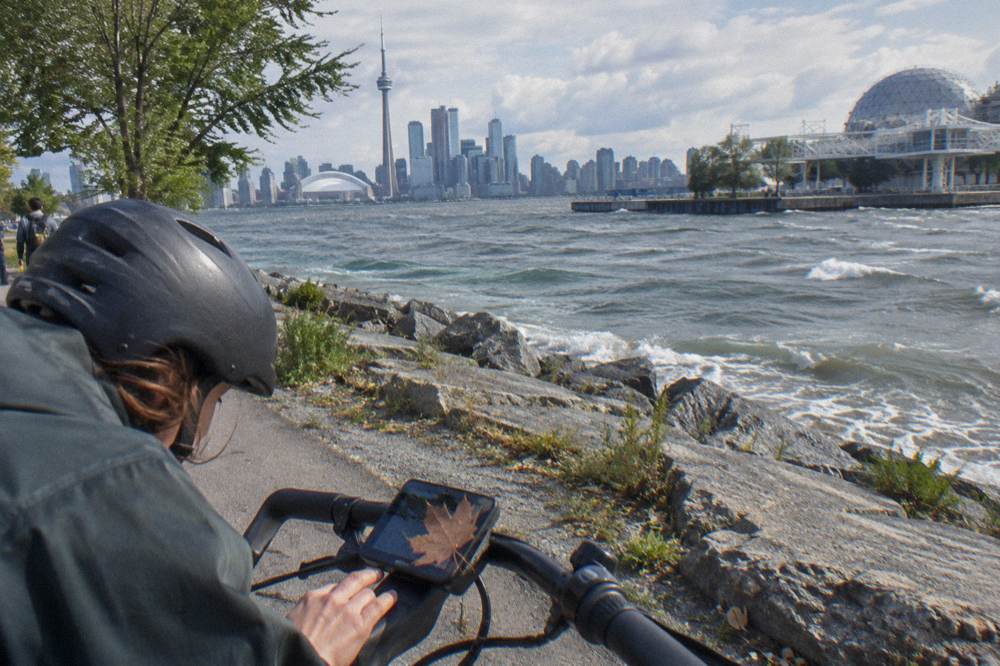
Weather is the other variable, and Toronto's climate normals give a sense of the season. July and August average daytime highs of 27.0 C and 26.1 C, September cools to 22.0 C, and by October the average high falls to 14.6 C with overnight lows near 7.7 C. Cold reduces effective battery range somewhat and headwinds pick up in the shoulder seasons, so an autumn e-bike booking is arguably the smartest use of the motor: the same wind that makes a regular-bike waterfront ride bracing in October barely registers with assistance.
There is a maintenance dimension too. E-bikes have more parts that need care, and a guided tour takes that responsibility off you entirely compared with a self-guided rental. If the motor has an issue mid-ride, that is the operator's problem to solve, which is a genuine point in favour of the guided e-bike option over renting one and routing yourself. The trade-offs of doing it alone are laid out in which guided bike ride to book in Toronto, including the rental-versus-guided question, on Bike Tours Toronto.
What About Hills, Wind And Fitness On Each Route?
Toronto's routes are flat to gently rolling, so the regular bike is genuinely viable everywhere. The e-bike earns its keep on the lake headwind, on the sustained distance of a 3.5-hour ride, and for groups with mixed fitness. Riders who cycle weekly will find the regular bike pleasant; riders who do not will find the second half of the ride a slog.
Break the decision down by route family and the answer sharpens. Downtown and neighbourhood rides spend time on streets with traffic lights, gentle rises and short bridges: effort comes in bursts, which favours the e-bike's acceleration but suits a regular bike fine too. Waterfront and Islands rides are flatter and longer between stops, so wind rather than gradient is the whole story, and a westerly wind can turn the return leg of a waterfront ride into work. The Islands themselves are pancake-flat and car-free, the friendliest regular-bike territory in the city.
| Route family | Terrain | Main effort factor | Better bike for a casual rider |
|---|---|---|---|
| Downtown neighbourhoods | Flat to gently rolling, traffic lights | Start-stop effort, distance | E-bike, for the assist on starts |
| Waterfront trail | Flat, exposed | Headwind, sustained distance | E-bike, or regular with wind awareness |
| Toronto Islands | Flat, car-free paths | Duration only | Either; regular bike is fine |
| Distillery and east end | Flat with short bridges | Distance | Either |
Fitness honesty matters more than terrain honesty here. A 3.5-hour ride with a guide is not a sprint, but it is also not a 30-minute loop. If your weekly exercise is walking, book the e-bike and enjoy yourself. If you ride a bike to work, the regular bike saves money and loses nothing. And if you are a couple where one of you rides and the other does not, the e-bike option is what keeps the tour a shared experience rather than a waiting exercise.
The Waterfront and Islands guided ride above is the clearest regular-bike case in the set: flat terrain, island paths and a route built for conversation pace, where the motor would mostly be insurance against the wind.
How Much More Does An E-Bike Tour Cost Than A Regular Bike Tour?
There is a consistent gap between e-bike and regular-bike guided rides, but the exact figures sit on each booking page and shift with season and availability, so treat any single printed number with caution. The structure is simple: e-bike listings are priced per person above their regular-bike equivalents, reflecting the cost of the machines. Both twins of the same product should be compared side by side before booking.
The honest way to compare is to open the e-bike neighbourhood listing and the regular-bike downtown listing on the same day and read the per-person prices together with what is included. Snacks are flagged on some listings and not others, and a snack stop can quietly change the value of a comparison. The listings state 3.5 hours for both, so you are comparing like with like on time.
| Cost factor | E-bike tour | Regular-bike tour |
|---|---|---|
| Bike provided | Electric, motor capped at 32 km/h assisted | Standard bicycle |
| Typical duration | 3.5 hours | 3.5 hours |
| Snacks | Check inclusions on the booking page | Included on the downtown ride per the listing title |
| Price basis | Per person, on the booking page | Per person, on the booking page |
| Cancellation | Stated on the booking page | Stated on the booking page |
Two cautions from the fine print. First, do not call either option cheap or the cheapest without the live numbers in front of you; prices move with season. Second, remember the twin-listing trap: the e-bike product appears on more than one booking page, and the regular-bike downtown ride does too. Comparing an e-bike twin against the non-twin regular ride at different times of year will distort the gap. Read both on the same day.
The broader context on what riding anything costs in this city, from day passes to rentals, is in the guide to renting a bike in Toronto and what it costs, which covers the self-guided alternative if you decide no tour at all fits your budget.
Which Bike Should You Actually Book?
Book the e-bike if wind, duration or mixed fitness is your concern, or if anyone in your group wants the ride to feel effortless. Book the regular bike if you cycle regularly, want the Islands or the waterfront routes, or prefer to spend less on the same 3.5 hours. There is no wrong answer physically: Toronto is flat enough for either, and the law makes neither safer than the other beyond the helmet requirements.
The deciding questions are social and physical, not topographic. A solo confident rider on the downtown route has no reason for a motor. A family with one keen cyclist and three reluctant ones has every reason. Wind matters most on the waterfront and least on the Islands, sheltered from the lake's worst by the city itself on the near side and open to it on the far shore.
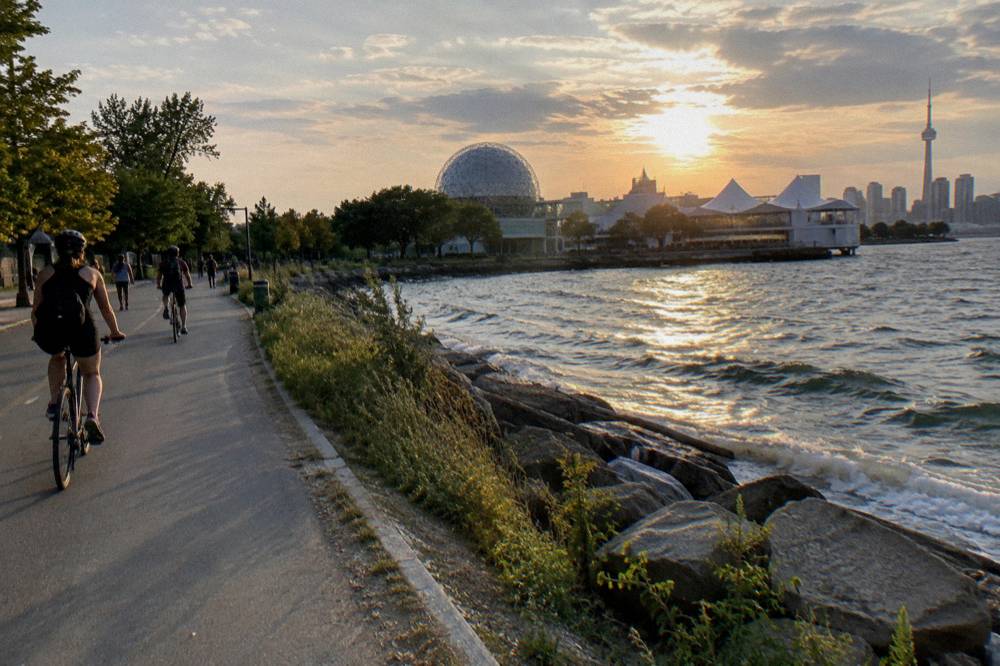

Timing nudges the answer too. In July and August, with average highs near 27 C, the motor's assistance also means less sweating, which is not a trivial thing before an afternoon elsewhere in the city. In October, at an average high of 14.6 C, comfort matters less and the wind matters more. November's average high of 8.1 C with roughly nine days of 1 mm-plus precipitation is late-season territory where most casual riders will have stopped booking either bike, and tour schedules narrow accordingly; check the booking page for what is running.
The Islands morning or twilight ride above is the classic regular-bike booking: flat, car-free paths, a choice of cooler hours, and a route where the motor would add almost nothing for a reasonably active rider.
There is a strand of infrastructure news worth knowing even though it does not change the bike-type choice: Ontario completed removing the protected bike lanes on a 1.2 km stretch of Bloor Street West in Etobicoke on 30 October 2026, the first removal under the provincial plan, following an Ontario Court of Appeal ruling on 14 August 2026. Guided tours route on their own paths, and the downtown tours' routes are set by operators who track these changes, but if you extend your day with self-guided riding, the current lane map is worth a look before you head out on Bloor west of downtown.
The evening Islands variant above suits the same regular-bike crowd at a different hour, which is the last real axis of the decision: not which bike, but which light.
Common Questions About E-Bike Or Regular Bike On A Toronto Tour
Is An E-Bike Tour In Toronto Worth It If The City Is Flat?
Often yes, because the value is not in climbing. It is in the lake headwind, the 3.5-hour duration of a guided ride, and keeping mixed-fitness groups together. If you ride a bike regularly, the regular-bike tours deliver the same routes for less effort on your wallet.
Do I Need A Licence For An E-Bike Tour In Toronto?
No. Ontario treats e-bikes as bicycles for licensing purposes. You must be 16 or older and wear an approved helmet, and the bike's motor cannot exceed 500 watts with assisted speed capped at 32 km/h.
Can Anyone Under 16 Ride An E-Bike On A Tour?
No. Ontario law sets the minimum e-bike rider age at 16. Families with younger teenagers should book regular-bike tours, where helmets are mandatory for riders under 18.
Can I Take An E-Bike On The Ferry To The Toronto Islands?
Yes, at staff discretion. E-bikes must be powered off on board, cannot be charged on the ferry or at the terminal, and larger e-bikes roughly 40 kg and over may be directed to the vehicle ferry. Bike Share bicycles are not permitted on the ferries at all.
What Happens If The Battery Runs Out During The Tour?
The bike becomes a heavier regular bike; you are not stranded. In practice a 3.5-hour conversational ride on flat terrain does not drain a healthy battery, but ask the operator about the range of the specific bikes they use rather than relying on general figures.
Are The E-Bike Tours The Same Length As The Regular-Bike Tours?
Yes. The e-bike neighbourhood rides and the regular-bike downtown and Islands rides all list about 3.5 hours, so duration is not a differentiator. The bike type and the route are what you are choosing between.