Toronto Cycling Rules: Helmets, Sidewalks And E-Bike Law
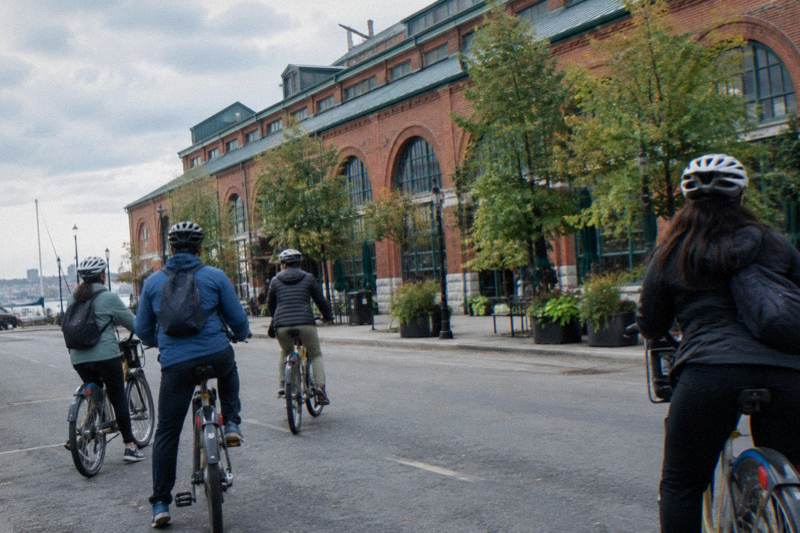
Ontario sets the cycling rules for Toronto, and most of them are simple: helmets for riders under 18, no sidewalk riding for adults, lights at night, and firm limits on what counts as an e-bike. Here is what the law actually says and how it shapes a day on the water.
Short answer
Ontario law requires cyclists under 18 to wear an approved helmet, bans sidewalk riding except for children under 10, and requires a bell or horn plus lights or reflectors at night. E-bike riders must be 16 or older, helmeted, and limited to 32 km/h assisted speed. Booked rides typically supply the required equipment; check the booking page to confirm.
Toronto's cycling rules are set by the province, not the city, and that matters for visitors because they apply everywhere in Ontario: on the waterfront trail, in the Islands, on Bloor, and on a rented e-bike alike. The core of it fits in a sentence or two. Riders under 18 wear an approved helmet, adults stay off the sidewalks, every bike carries a bell or horn, and after dark you need a white front light and a red rear light or reflector. E-bikes are their own category with an age floor and a speed cap.
That is the summary. What follows unpacks each rule the way a visitor actually meets it, on a rented bike, on a guided ride, or on a ferry to the Islands, and points to where the official Ontario pages say it in full. This article is a plain-language summary, not legal advice, and no fine amounts are verified anywhere on this site, so treat the province's own pages as the last word. If you would rather not think about any of it, a booked ride handles equipment and route etiquette for you; the E-Bike Ride, Snacks Included option on Bike Tours Toronto is one way to do exactly that.
What Are The Cycling Rules In Toronto?
Ontario's rules apply citywide: a bell or horn on every bike, a white front light and red rear light or reflector after dark, reflective tape on the front forks, helmets for riders under 18, and no sidewalk riding except for children under 10. E-bikes add a 16-and-over age floor, a helmet requirement for all riders, and a 32 km/h assisted speed cap.
The provincial equipment list is short and worth memorizing, because it applies to rental bikes too. Ontario requires a bell or horn in working order, a white front light and a red rear light or reflector when riding between half an hour before sunset and half an hour after sunrise, and reflective tape on the front forks. Brakes matter as well; the law expects a bike to stop properly. The full text lives on the Ontario bicycle safety page, and reading it takes five minutes.
One thing visitors often get wrong: these rules follow the road, not the rider. A bike rented in Toronto carries the same obligations whether you ride it on a quiet residential street, on the Martin Goodman Trail, or over the ferry to Centre Island. The trail network is multi-use, so the bell is not a formality there; it is the tool the rules give you for passing people on foot.
| Rule | What Ontario says | Who it applies to |
|---|---|---|
| Helmet | An approved bicycle helmet is required by law | Every cyclist under 18 |
| Sidewalks | Riding a bicycle on sidewalks is not allowed | Children under 10 may ride on the sidewalk |
| Bell or horn | Required equipment on the bicycle | All riders |
| Night riding | White front light, red rear light or reflector | All riders, dark hours |
| Reflective tape | Required on the front forks | All riders |
| E-bike age and helmet | Rider must be 16 or older and wear an approved helmet | All e-bike riders, any age |
Do You Have To Wear A Helmet On A Toronto Bike Ride?
Only if you are under 18. Ontario law requires every cyclist under 18 to wear an approved bicycle helmet, and the duty to enforce it falls on parents and guardians for riders under 16. Adults may legally ride bareheaded, though the province's own safety page still recommends a helmet for everyone.
The wording is precise and worth knowing: the law names approved bicycle helmets, meaning ones that meet the standards the province recognizes, not any hat-shaped object. For a family visit, the practical reading is simple. Book a ride with children and the operator expects helmets on the kids; most tour operators supply them, but check the booking page rather than assuming, because inclusions are listed per tour and vary.
For adults the question is a genuine choice. Nothing in Ontario law stops an adult from riding helmetless on Queens Quay or the Islands, and plenty of locals do. The reason this site does not tell you it is fine is that no safety claim here is backed by verified statistics, and none are needed: the rule is the rule, the rest is your judgment. If you want the reasoning laid out at more length, the companion piece on whether you can ride without a helmet in Toronto goes through the scenarios, including rentals and guided rides.
E-bikes are the exception that surprises people. The assisted-speed category has its own rule: riders must be 16 or older and must wear an approved bicycle or motorcycle helmet, at any age. So an adult who legally rides a regular bike bareheaded cannot legally ride an e-bike the same way. If a booked ride uses e-bikes, that is one of the reasons operators include helmets in the package.
Can You Ride A Bike On The Sidewalk In Toronto?
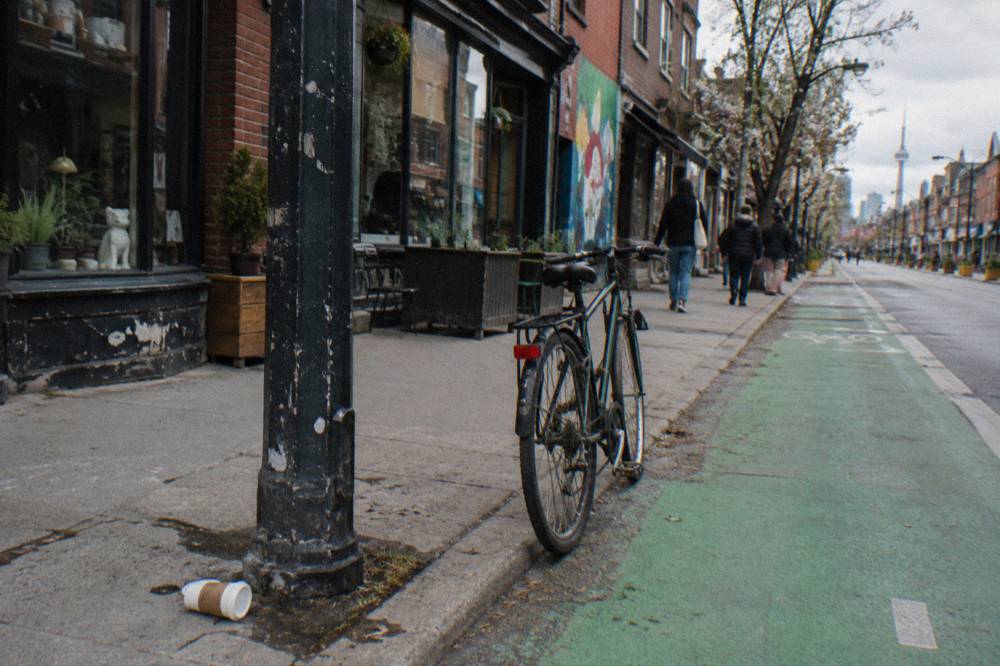
No, with one exception: riding a bicycle on sidewalks is not allowed in Toronto, but children under 10 may ride on the sidewalk. The rule is provincial and applies across Ontario, so it covers every neighbourhood and the Islands alike, and it exists because sidewalk riding puts pedestrians and riders in each other's blind spots.
Visitors from places where sidewalk cycling is tolerated sometimes find this the hardest habit to break. The streets that feel busiest, like King Street or Bay Street, are exactly the ones where a bike belongs in the lane, and Toronto's network gives you better options anyway: 110.1 km of cycle tracks and 143.8 km of bicycle lanes as of December 2025, plus 399.3 km of multi-use trails. The bike lanes and path map guide on this site shows where those actually run, which is the practical answer to not wanting the road.
The under-10 exception reflects the way small children ride: slowly, wobbling, with a parent alongside. A ten-year-old on a full-size bike is expected to be in the lane or on a trail. If you are riding with kids of mixed ages, the split can feel awkward; family-friendly guided rides solve it by routing on trails and quiet streets, and the operator sets the pace.
There is a deeper dive on this exact question, with the parking-lot and crosswalk edge cases, in can you ride a bike on the sidewalk in Toronto. The short version for planning: build your route on the trail network, treat sidewalks as places to walk your bike, and the question never arises.
What Are The E-Bike Rules In Ontario?
An e-bike rider in Ontario must be 16 or older and wear an approved bicycle or motorcycle helmet, the motor must not exceed 500 watts, the bike must not weigh more than 120 kg, and the maximum assisted speed is 32 km/h. Power-assisted pedalling stops helping above that speed even though you can pedal faster.
Those four numbers, on the Ontario e-bike page, define the whole legal category. A bike inside those limits is treated as a bicycle for most purposes: it goes in bike lanes, on trails where bikes are allowed, and it follows the same road rules as any pedal bike. A machine outside them is not an e-bike in law, and riding one carries different obligations entirely.
| E-bike limit | Ontario rule | What it means for a rider |
|---|---|---|
| Minimum age | Rider must be 16 or older | No e-bikes for younger teenagers, even with a parent along |
| Helmet | Approved bicycle or motorcycle helmet, all ages | Adults who skip helmets on regular bikes must wear one here |
| Motor power | Not exceeding 500 watts | Tour and rental e-bikes are built inside this limit |
| Weight | Maximum 120 kg | Covers the machine, not the rider |
| Assisted speed | Maximum 32 km/h | The motor stops assisting above this; you can still pedal faster |
For visitors the numbers matter in two specific places. First, on a booked ride: tour e-bikes are built to stay inside the category precisely so they can use the lanes and trails, and the operator's listing states what bikes the ride uses; if the listing flags a snack stop and an e-bike format, the machines are compliant ones. Second, on the ferry: e-bikes are welcome at the discretion of staff, must stay fully powered off onboard, cannot be charged onboard or at the terminal, and larger e-bikes, roughly 40 kilograms and over, may be directed to the vehicle ferry. Toronto Island Park adds its own limit, with e-bikes over 40 kg not allowed in the park.
The distinction between an e-bike and a scooter-style machine confuses a lot of readers, and the e-bike guide on this site covers the borderline cases; start with are e-bikes illegal in Toronto for the legal categories.
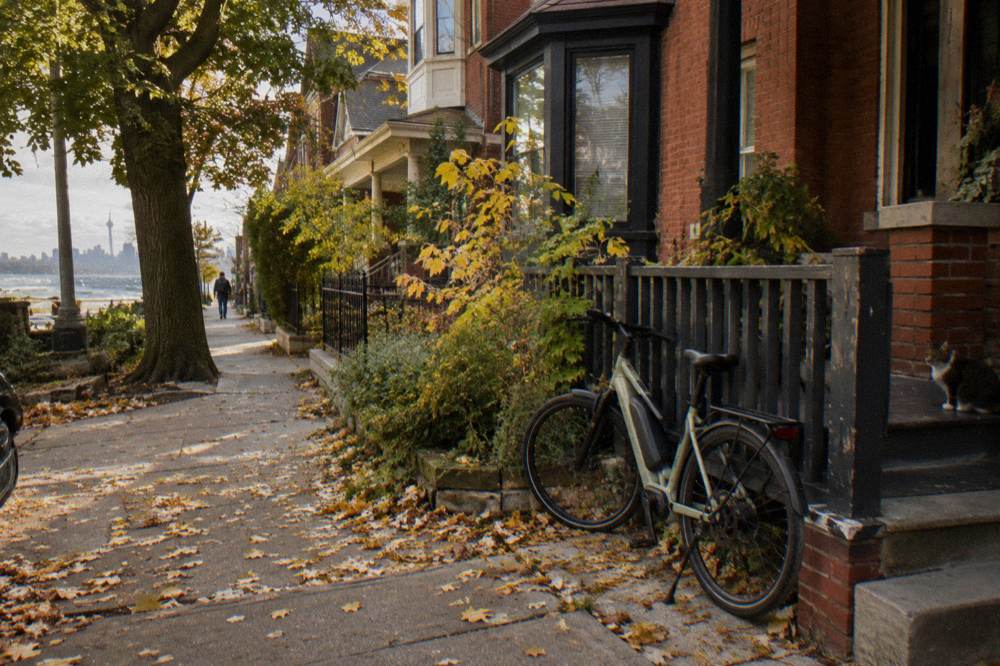
Can You Take A Bike On The Toronto Island Ferry?
Yes, bicycles are welcome on the ferry, you walk them on and off, and no separate bike fare is published on the City's ticket page; the round trip costs an adult $9.57, with older adults and youth at $6.15 and juniors at $4.51, in Canadian dollars. Bike Share bicycles are not permitted on the ferries at all.
The fare table is on the City ferry ticket page, and those figures are Canadian dollars, so do not mix them into any US-dollar comparison with tour prices. Tickets are round-trip and valid at any dock, and online tickets are valid to year-end. The season matters as much as the fare: from 14 October 2026 the winter schedule serves Ward's Island only, with no Centre Island or Hanlan's Point sailings until mid-April 2027, and full three-route service returns mid-May. Confirm sailing times on the City's ferry routes page before you go.
| Ferry detail | What applies |
|---|---|
| Adult round trip | $9.57 Canadian |
| Older adult (65+) and youth (15 to 19) | $6.15 Canadian |
| Junior (2 to 14), infant (under 2) | $4.51, free |
| Bicycles | Welcome; walk them on and off |
| Bike Share bikes | Not permitted on the ferries |
| E-bikes | At staff discretion, powered off, no charging; about 40 kg and over may go to the vehicle ferry |
The Bike Share exclusion is the trap that catches unprepared riders. A docking bike that cannot leave the system cannot board the boat, so an Islands ride on a Bike Share bike is not a thing; either rent on the island, where Toronto Island Bicycle Rentals and Bike Share both operate, or ride a tour bike or a private rental across. The comparison of the two approaches is laid out in the island bike rental or guided ride guide, and the full logistics, queue reality and seasonal schedule are in the ferry with a bike guide.
What Lights And Equipment Does Ontario Require At Night?
Ontario requires a white front light and a red rear light or reflector between half an hour before sunset and half an hour after sunrise, a bell or horn at all times, reflective tape on the front forks, and working brakes. Night riders should assume rentals do not include lights unless the booking page says so.
The timing rule is the part people miss. It is not "after dark", it is a half-hour window around sunset, which in Toronto swings across a wide range through the year. The ECCC 1991 to 2020 normals for the city show why planning matters: December averages a high of 2.6 C and a low of minus 2.7 C with about 57.8 mm of precipitation, while July runs 27.0 C and 18.1 C, and late-fall rides in November, averaging a 8.1 C high, can start in daylight and finish inside the lighting window. A guided twilight ride plans for this; a self-guided rental needs you to ask.

Equipment is the area where a booked ride genuinely removes a task. Tour operators ride the same routes daily and their bikes carry the legal kit because the operator carries the liability that goes with it. If you are renting independently, the checklist is short: bell, lights if you will be out late, helmet for anyone under 18 in your group, and a lock if the rental does not include one. The packing guide on this site, what to bring on a Toronto bike ride, lists the rest, from layers to a water bottle for the July normals.
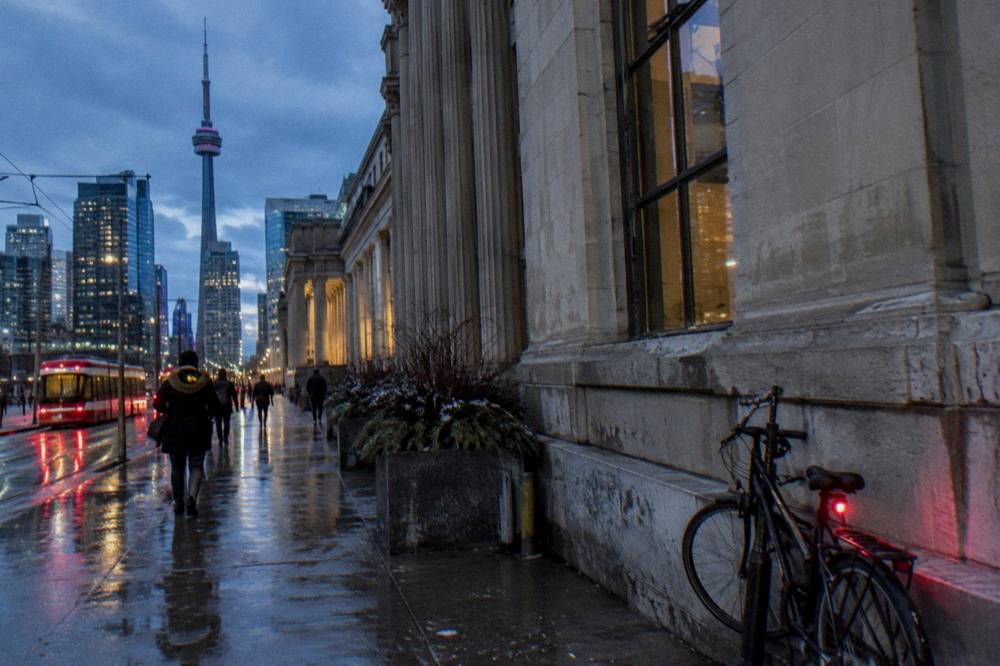
Where Are You Allowed To Ride In 2026?
In 2026 the legal picture and the street picture diverged: Ontario law did not change for riders, but the province removed the 1.2 km Bloor Street West protected lanes in Etobicoke on 30 October 2026, the Martin Goodman Trail on Parliament Street is closed until 31 December 2026, and the downtown network otherwise stands as of December 2025.
The Bloor removal matters to route planning because it was the first under the province's removal plan, and a September 2026 request for proposals covers roughly 19 km of Bloor, Yonge, University, Queen's Park and Avenue Road for lane removal or reconfiguration, with major construction expected from spring 2027. None of this changes your obligations as a rider; it changes which streets have protected space. The network-status figures, 110.1 km of cycle tracks and 346 km of on-street cycling as of December 2025, predate the removals, so treat them as a floor rather than a live count.
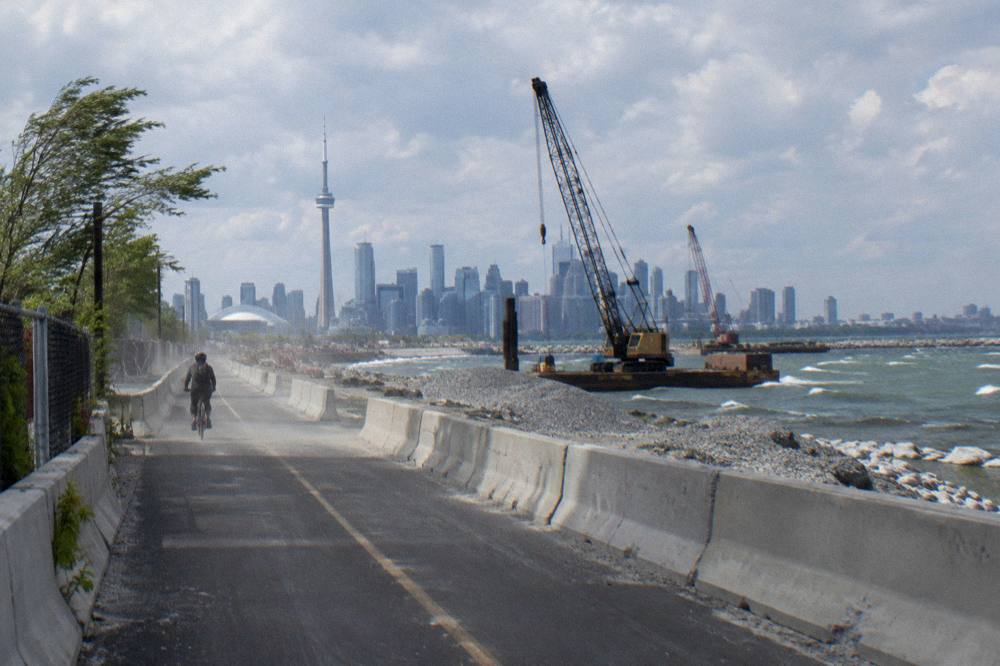
The Parliament Street closure is more directly a waterfront-riding issue. Since 22 April 2026 the Martin Goodman Trail between Merchant's Wharf and Lake Shore Blvd East has been shifted onto a temporary bi-directional lane behind concrete barriers while the Queens Quay East realignment proceeds, and the detour runs to 31 December 2026. The trail itself, 20-plus km along the waterfront from the western to the eastern beaches as part of a network of over 300 km of city trails, remains the spine of any water-side ride; the Martin Goodman Trail cycling guide tracks the specifics.
Guided rides absorb this kind of churn without you noticing. An operator re-routes around a construction detour as a matter of course, and a guide who rides the waterfront weekly already knows which side street replaced the closed trail section. That is a quiet argument for a booked ride in a year when the street network is genuinely in motion.
Does Booking A Guided Ride Handle The Rules For You?
Mostly, yes: a booked ride supplies a bike with the legally required bell and lights, a helmet where the law or the operator's policy demands one, and a guide who routes on legal, current infrastructure, which in 2026 means avoiding the Bloor West gap and the Parliament detour. Confirm specific inclusions on the booking page, since they vary by tour.
The division of labour is worth stating plainly. The law attaches to the rider, but the equipment obligations attach to the bicycle, and tour bikes are maintained to meet them as a condition of the operator's business. The age and helmet rules still apply to your family exactly as written; what disappears is the chore of sourcing compliant equipment in an unfamiliar city. The remaining items, riding predictably, signalling, keeping to the right in a lane, are the same etiquette a guide models anyway.
Choosing between the formats comes down to where you want the guide. The downtown neighbourhoods option covers the core streets where the sidewalk rule and lane etiquette matter most; the e-bike version of that ride suits anyone who wants the hills flattened; the waterfront and Islands ride puts most of its distance on trail, where the ferry rules above are the ones you will actually touch. All three run about 3.5 hours, and every one of them is listed with snacks or breakfast flags that vary by tour, so read the inclusions on the booking page before you choose. For a fuller comparison of which ride fits which traveller, the which guided ride to book guide walks through the decision. And if you plan to ride without a guide at some point, the sidewalk rules for cyclists in Toronto explains where you can legally roll.
One last framing helps. Toronto's rules are not onerous; they are a short list that mostly matches what a considerate rider does anyway. The genuine friction for a visitor is logistics, getting a compliant bike, a helmet that fits a child, a route that avoids a construction detour, and a ferry ticket in the right season. A guided ride resolves all four at once, and independent riders can resolve them one at a time with the guides linked above.
Common Questions About Toronto Bike Rules
Do You Have To Wear A Helmet On A Toronto Bike Ride?
Ontario law requires an approved helmet for every cyclist under 18. Adults may legally ride without one on a regular bicycle, but e-bike riders of any age must be 16 or older and wear an approved helmet.
Can You Ride A Bike On The Sidewalk In Toronto?
No, sidewalk riding is not allowed, with the exception of children under 10. Adults walk their bikes on sidewalks and ride in bike lanes, cycle tracks or multi-use trails instead.
What Equipment Does A Bike Need In Ontario?
A bell or horn, a white front light and a red rear light or reflector for night riding, reflective tape on the front forks, and working brakes. Rentals from established operators normally carry this kit, but confirm on the booking page.
Are E-Bikes Legal In Toronto?
Yes. A legal e-bike in Ontario has a motor of no more than 500 watts, weighs no more than 120 kg, and assists only up to 32 km/h; the rider must be 16 or older and helmeted. Anything outside those limits is a different vehicle category.
Can You Take A Bike On The Toronto Island Ferry?
Yes, bicycles are welcome and you walk them on and off. The adult round trip costs $9.57 Canadian, and Bike Share bicycles are not permitted on the ferries. E-bikes travel at staff discretion, powered off, with larger machines possibly directed to the vehicle ferry.
Do The Rules Change On The Toronto Islands?
The provincial rules follow you across the water: helmet law, equipment rules and the e-bike definition all apply. The park adds its own limits, including no e-bikes over 40 kg, and private vehicles are not present on the islands at all.