Where To Bike Ride In Toronto?
Where to bike ride in Toronto: the waterfront trail, the Islands, downtown neighbourhoods and the Don Valley, with closures, ferry fares and guided ride pairings.
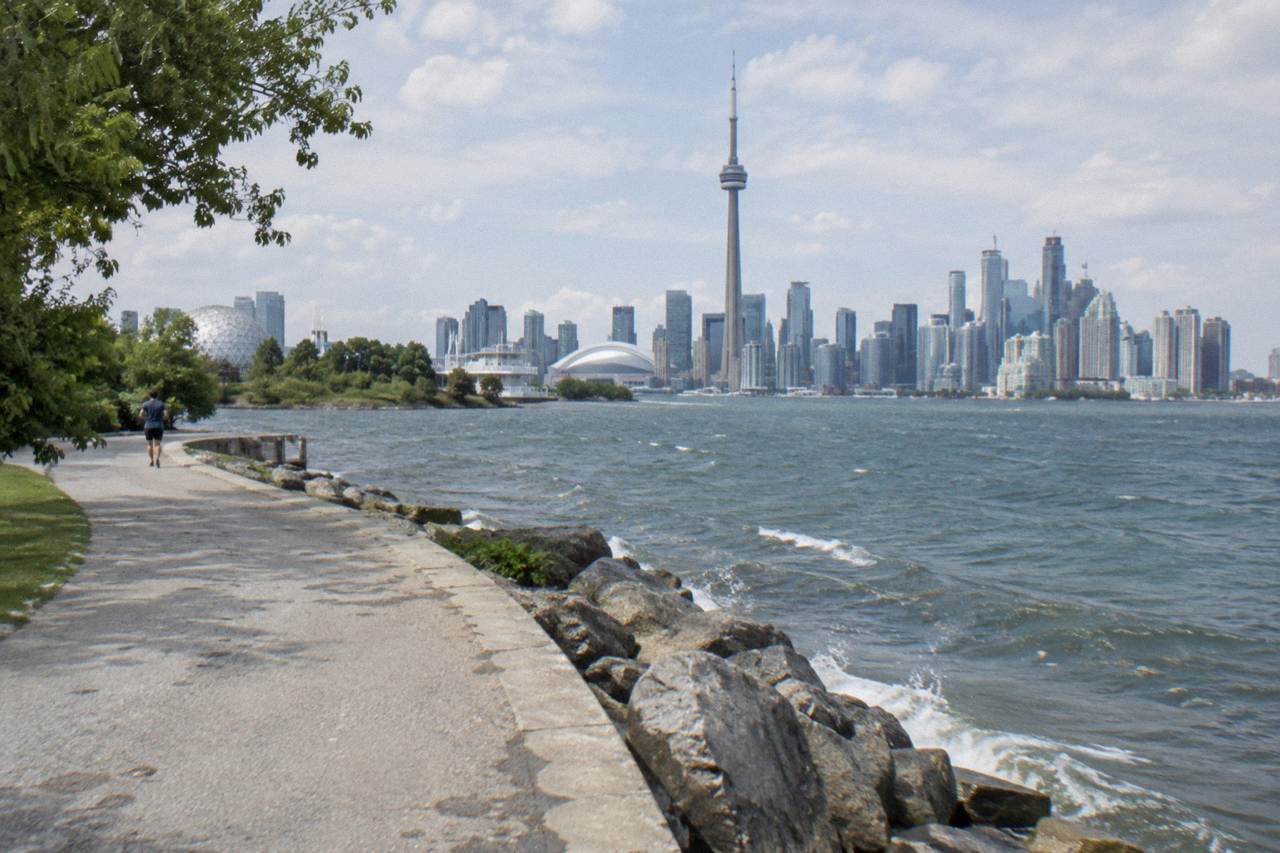
The best places to bike ride in Toronto are the Martin Goodman Trail along the waterfront, the car-free Toronto Islands, the downtown neighbourhoods around Kensington Market and the Distillery District, and the Don Valley trail network east of the core. Toronto counts 346 km of on-street cycling routes plus 399.3 km of multi-use trails as of December 2025, so a visitor has to choose rather than cover it all. If you'd rather give your legs a rest between rides, this guide to getting around Toronto without a car covers transit, bike share, and the ferry out to the Islands.
That choice shapes everything else about the day. The waterfront is flat, continuous and easy to follow, which makes it the default first ride for most visitors. The Islands add a ferry crossing and car-free paths, which feels like a different city entirely. The downtown core packs the most per kilometre: markets, Chinatown, the financial district and the Distillery District all sit within a compact loop. The Don Valley is the quiet option, a wooded valley route where you forget a highway runs nearby.
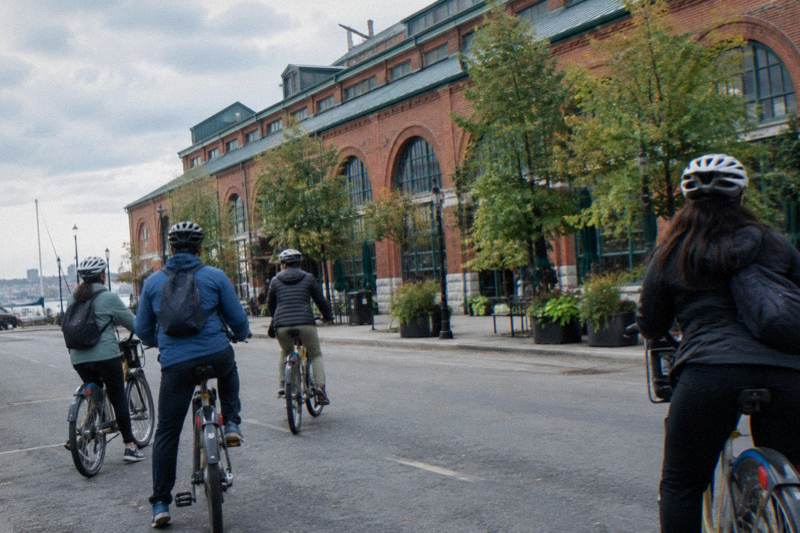
Two guided rides fit this question naturally. A downtown guided ride such as the Heart of Downtown 3.5-hour bike tour strings the core neighbourhoods together with snacks included, and a waterfront and Islands guided ride covers the shoreline and the ferry crossing in one outing. For current prices and meeting points, check the booking page for each.
This article walks through each of the four areas in turn: what the riding is actually like, what it costs where a real figure exists, what closures to expect in 2026 and 2027, and which guided ride pairs with which area. Facts on fares, trail distances and construction come from the City of Toronto, the Province of Ontario and the Toronto and Region conservation Authority. Where a detail is not published, the honest answer is to check the booking page or the City's own pages before you go. If the wider question of whether the city deserves your travel days is still open, the honest case for and against visiting Toronto makes a good companion read.
The Waterfront: Martin Goodman Trail And Queens Quay
Ride the Martin Goodman Trail. It is a 20+ km paved multi-use route that runs along Toronto's waterfront from the western beaches to the eastern beaches, part of a network of over 300 km of trails inside the city. It is flat, free to ride and busy near Harbourfront and Ontario Place, so go early on summer weekends.
The trail is the spine of Toronto cycling. You can join it anywhere along Queens Quay and ride west toward Exhibition Place and the Humber Bay area, or east toward Sugar Beach, the Port Lands and the eastern beaches at Woodbine. The surface is paved and multi-use, shared with pedestrians, so the etiquette is simple: call out or ring before passing, and expect the Harbourfront stretch to slow to walking pace on a July afternoon. The City describes the trail as completing a 20+ km waterfront run with the Unwin Avenue section added in 2019.
One closure matters for east-end riders. The Martin Goodman Trail on Parliament Street, between Merchant's Wharf and Lake Shore Boulevard East, is closed from 22 April 2026 to 31 December 2026 while the Queens Quay East and Parliament Street realignment work proceeds, with a temporary two-way protected bicycle lane carrying riders through the work zone. The trail between Merchants' Wharf and Lake Shore stays shifted onto that temporary lane, separated by concrete barriers, through the Quayside construction project. If your route heads east of the Don River, check the current construction notices before you set out.
Farther east, the Port Union Waterfront Park shoreline maintenance project keeps the multi-use trail open but has caused intermittent detours and short closures for truck access, with a signed gravel detour, into late November 2026. The Rouge Beach section of the Waterfront Trail at the Scarborough and Pickering border remains closed with a long-term detour, and full reopening is not expected until 2027. None of this touches the core waterfront between the Humber and the Don, which remains the most reliable stretch in the city.
A guided option covers exactly this ground without the planning. The 3.5-hour Waterfront and Islands guided bicycle tour pairs the shoreline with the ferry crossing, which is the single most efficient way to see both halves of Toronto's waterfront riding in one morning or afternoon.
The Toronto Islands: Car-Free Paths And A Ferry Crossing
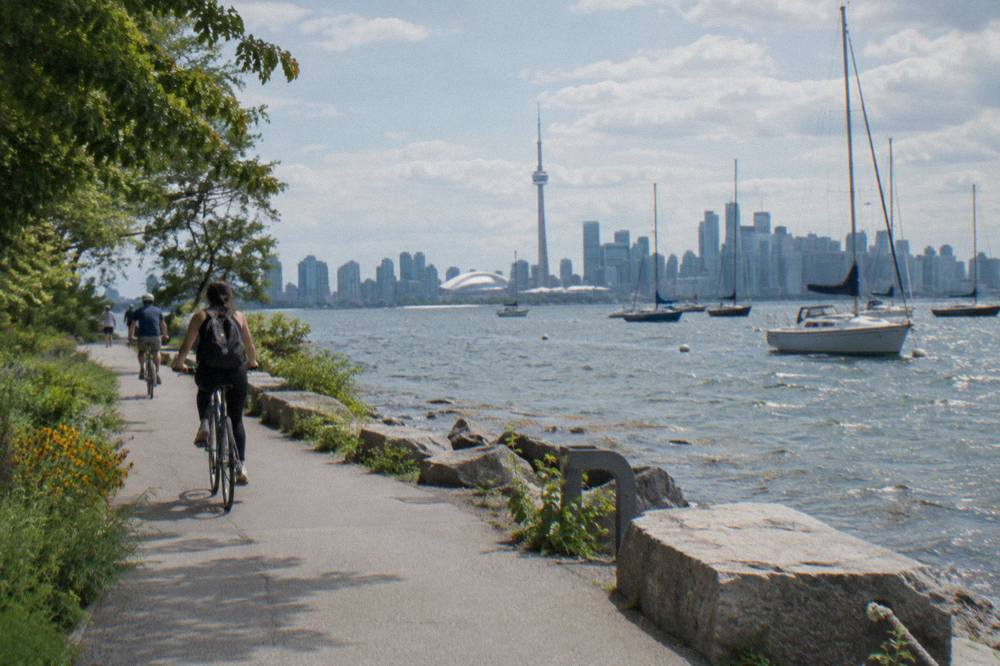
Ride the Toronto Islands. The islands have paved and gravel trails with no private cars, reached by ferry from the Jack Layton Ferry Terminal. The adult round-trip ferry fare is $9.57 in Canadian dollars, bicycles are welcome on board and you walk them on and off. From mid-October 2026 to mid-April 2027 the ferry runs to Ward's Island only.
The islands are the closest thing Toronto has to a car-free cycling paradise. Paths connect Hanlan's Point, Centre Island and Ward's Island past beaches, gardens and open meadow, and the skyline view across the water is the classic Toronto photograph. Ordinary bicycles ride onto the ferry at no separate bike charge beyond your passenger fare, though Bike Share bicycles are not permitted on the ferries, so a mainland Bike Share bike cannot come with you. Rentals exist on the islands themselves.
E-bikes have extra conditions. The ferry welcomes them at the discretion of staff, requires them fully powered off on board, permits no charging on board or at the terminal, and may direct larger e-bikes, roughly 40 kilograms and over, to the vehicle ferry. Ontario law separately requires e-bike riders to be 16 or older, wear an approved helmet, and stay within a 32 km/h assisted speed and a 500 watt motor limit. Our e-bike or regular bike comparison covers which choice suits the islands.
The seasonal schedule is the thing most visitors miss. Winter service from 14 October 2026 runs to Ward's Island only, with frequent daily departures from the city from roughly 6:30 a.m. into the late evening, and no service to Centre Island or Hanlan's Point until reduced three-route service resumes around mid-April 2027. Full summer service on all three routes runs from mid-May to mid-September. Youth aged 15 to 19 and older adults pay $6.15 round trip, juniors $4.51, and infants ride free. Fares are in Canadian dollars, separate from any tour pricing in US dollars. The City's ferry ticket page has the full fare table, and the sailing schedule page should confirm your date before you commit.
| Ferry fact | Detail |
|---|---|
| Adult round trip | $9.57 (Canadian dollars) |
| Older adult and youth round trip | $6.15 |
| Junior (2 to 14) round trip | $4.51 |
| Infant (under 2) | Free |
| Winter service from 14 Oct 2026 | Ward's Island only, until mid-April 2027 |
| Bicycles | Welcome, walked on and off; Bike Share bikes not permitted |
| E-bikes | Staff discretion, powered off, larger units may use vehicle ferry |
Two guided rides do the islands well. The Morning or Twilight Islands Ride runs 3.5 hours and lets you pick the cooler end of the day, while the Sunrise Ride with breakfast included is a quiet-start option, though it has only a handful of reviews so far, too few to treat its rating as evidence of anything. Our morning and twilight islands rides guide compares them in detail.
Downtown Neighbourhoods: Kensington, Chinatown And The Distillery
Ride the downtown core in a loop through Kensington Market, Chinatown, the financial district and the Distillery District. The distances are short, the streets are the busiest in the city, and the payoff per kilometre is the highest of any Toronto ride. A guided downtown ride pairs naturally with this route.
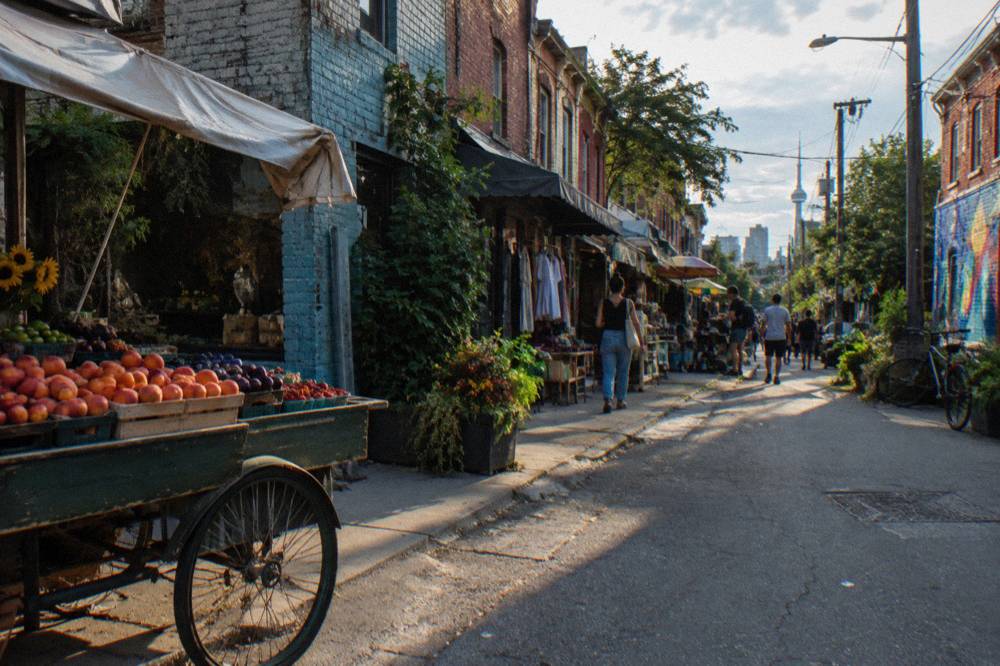
Downtown is where a guide earns their keep. The streets here carry the heaviest traffic, and the network of cycle tracks and bicycle lanes that makes it work, 110.1 km of cycle tracks and 143.8 km of bicycle lanes as of December 2025, is dense but not always intuitive to a first-time visitor. Kensington Market's car-free Pedestrian Sundays, held on the last Sunday of each month from May through October, turn the whole neighbourhood into a slow rolling festival, and the Kensington Flea Market runs Saturdays and Sundays from May to September at 216 Augusta Avenue, free to browse. The full index of guides sits on Bike Tours Toronto.
East of the core, the Distillery District is a pedestrian-only Victorian industrial precinct, so you arrive by bike and walk it. Outside event season its standard hours run 10 a.m. to 7 p.m. Monday to Thursday, 10 a.m. to 8 p.m. Friday and Saturday, and 11 a.m. to 7 p.m. Sunday. Note that bikes are walked, not ridden, through the district itself; the riding pleasure is in getting there along the eastern waterfront and through the St Lawrence Market area, where the South Market operates Tuesday to Sunday and a free winter market runs on Market Street from 19 November to 22 December 2026. Our Distillery District by bike guide maps the approach.
The Heart of Downtown Ride is the natural pairing for this area. It runs 3.5 hours with snacks included, and the booking page lists the current price and the exact meeting point. A guide here is not about safety in numbers so much as route knowledge: which lanes connect, where the market laneways open up, and when to dismount and walk. If downtown density appeals more than open shoreline, you can check availability alongside the downtown tour page.
Sequencing makes this loop easier than it looks. Start in Kensington on a Saturday or Sunday between May and September, when the flea market is running on Augusta Avenue and the neighbourhood is at full volume, then roll south and east through Chinatown while your legs are fresh. Take the financial district mid-ride, where the cycle tracks do the work of keeping you clear of the heaviest traffic, and finish along the eastern waterfront so the car-free Distillery arrives as a stretch you walk rather than one you ride.
The day matters more here than on most Toronto routes. The South Market trades every day except Monday, so Monday riders lean on the Distillery instead, and the free winter market on Market Street gives the loop a second season in late November and December. Aim for the last Sunday of the month between May and October if you want Kensington at festival pace, and budget time on foot, since the precinct itself is walk-only and the later Friday and Saturday closing time suits an evening finish.
Splitting the loop works too. With distances this short, half a day in Kensington and Chinatown and a separate half for the waterfront, St Lawrence and the Distillery still fit inside one weekend, each pairing with a snack stop rather than a full meal. Riders who would rather not puzzle out the lane connections can hand that job to the guided option and simply follow.
The Don Valley And The East Don Trail
Ride the Don Valley trail network for the quietest cycling in central Toronto. Phase 1 of the East Don Trail, a 3.3 km multi-use path, opened on 13 July 2026, connecting sections east of Don Mills Road to Bermondsey Road and linking into other Don Valley trails and The Meadoway. It is wooded, off-street and free to ride.
The Don Valley is the surprise for visitors who expect Toronto to be all towers and traffic. The valley floor trails run under forest cover beside the river, connecting the Evergreen Brick Works area, which itself hosts a pay-what-you-can Winter Market on four Sundays from late November 2026, to points north and east. Our Brick Works and Don Valley guide covers the route in full, including how the valley links to the waterfront at the trail's southern end.
The new East Don Trail segment is the headline for 2026. The Toronto and Region Conservation Authority opened the 3.3 km Phase 1 on 13 July 2026, closing a gap that previously forced riders onto busier streets around the Don Mills area. Combined with The Meadoway, the linear meadow corridor, the east Don now reads as a genuine alternative to the waterfront for a half-day ride. No guided tour currently covers this valley network; it is a self-guided ride, so bring a map app and check trail notices, since flood work and maintenance closures appear here more often than on the waterfront.
Rules, Helmets And What To Know Before You Ride
Ontario law requires cyclists under 18 to wear an approved helmet, bans riding on sidewalks except for children under 10, and requires a bell or horn plus lights and reflectors at night. Toronto's network stands at 346 km on-street and 399.3 km of multi-use trails as of December 2025. E-bike riders must be 16 or older.
These rules apply everywhere described above. The helmet law is provincial, so it covers the islands and the valley as much as downtown, and Ontario's bicycle safety page lists the required equipment in full: a bell or horn, a white front light, a red rear light or reflector when riding between dusk and dawn, and reflective tape on the forks. Guided tours supply the equipment with the bike, which removes most of the checklist; independent riders renting or using Bike Share should confirm lights come with the rental.
One piece of 2026 context affects downtown route planning, stated without politics. Ontario completed removing the protected bike lanes on a 1.2 km stretch of Bloor Street West in Etobicoke, between Clissold Road and Royal York Road, on 30 October 2026, following an Ontario Court of Appeal ruling on 14 August 2026 that roadway design is a matter for the legislature. A provincial request for proposals covering roughly 19 km of Bloor, Yonge, University, Queen's Park and Avenue Road closed around late November 2026, with major construction possible from spring 2027. None of that touches the core routes visitors actually ride, which run on the waterfront and through the downtown neighbourhood grid, but if your route uses Bloor west of the Humber, check current lane conditions.
| Rule | What Ontario requires |
|---|---|
| Helmets | Approved helmet mandatory under 18; recommended for all |
| Sidewalks | Riding not allowed; children under 10 may ride the sidewalk |
| Equipment | Bell or horn; white front light; red rear light or reflector at night; reflective tape on forks |
| E-bikes | Rider 16 or older, approved helmet, 32 km/h max assisted speed, 500 watt motor limit, 120 kg max weight |
The Best Season For Each Ride
The best months to ride in Toronto are May through September, when average highs run from 18.8 C to 27.0 C and monthly precipitation stays between 69.4 and 81.6 mm. July is the warmest and among the driest by rain days. The islands need the summer ferry schedule, mid-May to mid-September, for all three ferry routes.
The climate normals tell a straightforward story. June, July and August average highs of 24.2 C, 27.0 C and 26.1 C respectively, with 7 to 8 days per month of measurable rain. September stays pleasant at a 22.0 C average high and is noticeably quieter after the summer crowds. May warms to 18.8 C but carries 9.3 wet days, and October drops to 14.6 C, still rideable with layers. From November through March, average highs fall from 8.1 C to below freezing on average in January, and the islands shrink to the Ward's Island ferry only. Our best time of year to cycle guide works through the full calendar.
Season also changes the neighbourhood rides. The free summer concerts at the Toronto Music Garden ran on Thursdays and Sundays from late June to late August 2026, a natural finish line for a waterfront ride. In winter, the riding question shifts indoors toward markets: the Distillery Winter Village runs 12 November 2026 to 3 January 2027, though it requires tickets during peak evening hours, and the pay-what-you-can Evergreen Winter Market fills four Sundays at the Brick Works. Riding to the Brick Works in December is realistic on a mild day, and the valley trails are year-round multi-use paths.
With the seasons covered, the choice of where to ride comes back to what kind of day you want: shoreline, ferry and meadow, market laneways, or valley quiet. These three guided rides each answer that question differently, and availability moves fastest in the July and August peak:
Common Questions About Riding In Toronto
Where To Bike Ride In Toronto?
Ride the Martin Goodman Trail along the waterfront, the car-free Toronto Islands, the downtown loop through Kensington Market and the Distillery District, or the Don Valley trails including the new 3.3 km East Don Trail segment. A guided ride such as the 3.5-hour Heart of Downtown tour or the Waterfront and Islands tour covers two of these areas in one outing.
Is Toronto Good For Casual Cyclists?
Yes, for a city its size. The waterfront trail is flat and continuous for 20+ km, the islands have no private cars, and the downtown core has 110.1 km of cycle tracks as of December 2025. Busier streets are easier with a guide or a route planned in advance.
Do I Need A Helmet To Ride In Toronto?
Ontario law requires an approved helmet for riders under 18 and permits children under 10 on sidewalks. Adults are not legally required to wear one but are advised to. Guided tours supply helmets with the bike; confirm lights and bell if renting independently.
Can I Take A Bike On The Toronto Island Ferry?
Yes. Bicycles are welcome on board at no separate charge beyond the passenger fare, and you walk them on and off. Bike Share bicycles are not permitted on the ferries. E-bikes travel at staff discretion, powered off, with larger units possibly directed to the vehicle ferry.
Which Toronto Bike Ride Suits A First-Time Visitor?
The waterfront trail for a self-guided day, or the 3.5-hour Heart of Downtown guided ride with snacks included for the core neighbourhoods. Visitors who want the skyline view and car-free paths should pair the waterfront with an Islands ride. Check the booking page of whichever tour you choose for current prices and meeting points.