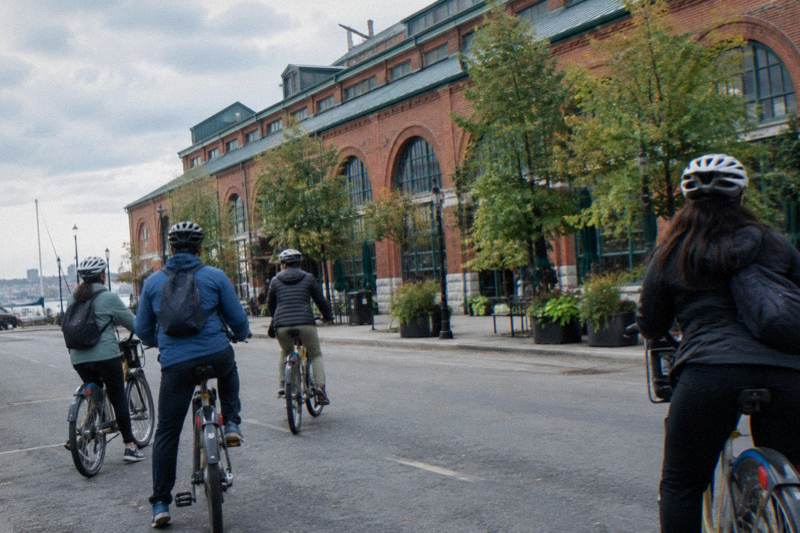
Getting Around Toronto Without A Car
Toronto is a city you can do entirely on foot, by ferry, on two wheels and on transit, and the parts visitors come for, the waterfront, the Islands and the downtown neighbourhoods, sit close enough together that a car mostly slows you down.
Short answer
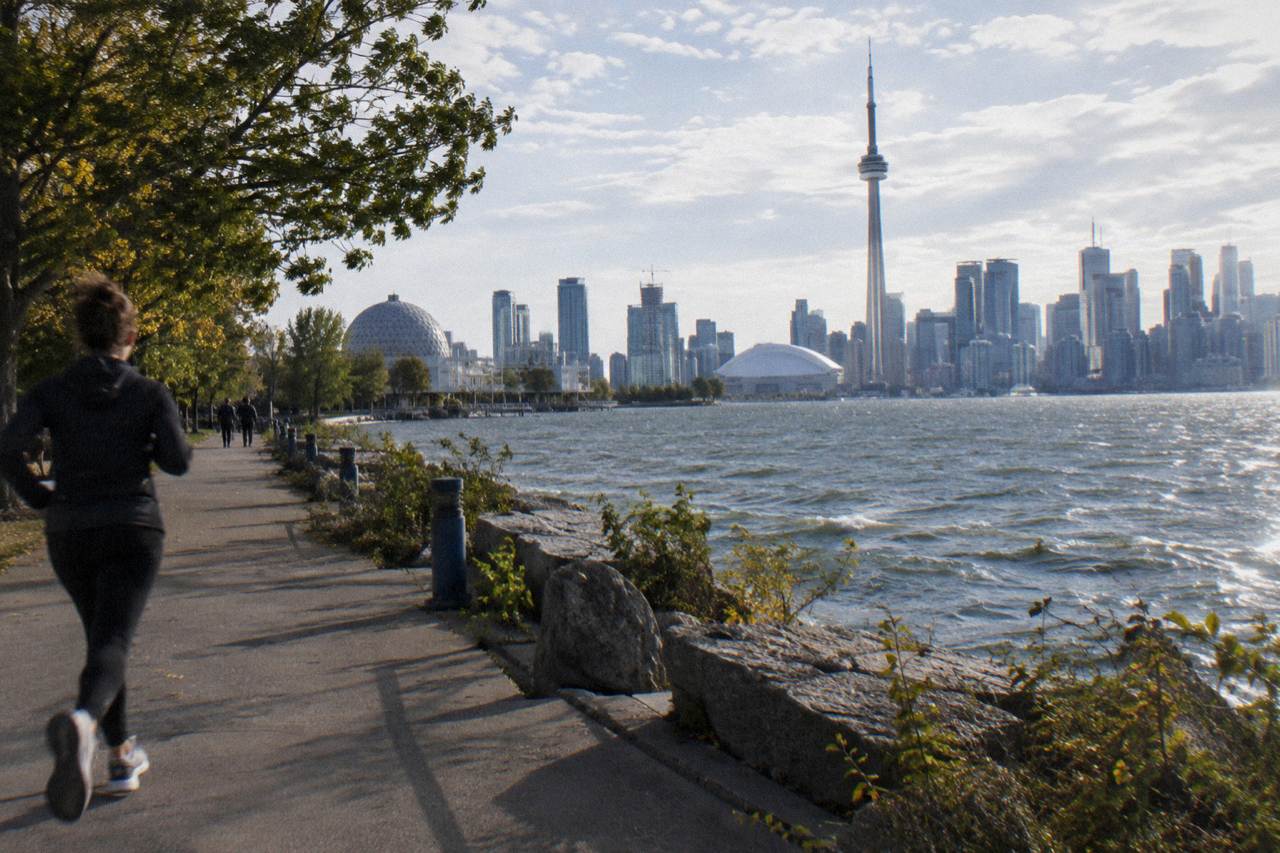
You do not need a car in Toronto. The downtown core, the waterfront trail and the ferry to the Islands cover most visitor itineraries on foot and by bike, with transit filling the gaps. Ferry round-trip fares run $9.57 for adults in Canadian dollars, and the Martin Goodman Trail links more than 20 km of waterfront you can ride for free.
Toronto spreads a long way east to west, but the strip visitors actually come for is narrow: the downtown core, the waterfront, the Islands and a handful of neighbourhoods clustered within a few kilometres of Lake Ontario. That geography is the reason a car is more burden than help here. Parking is scarce near the Distillery District and St. Lawrence Market, the Islands have no private vehicles at all, and the ferry terminal sits at the foot of a trail that runs the length of the shoreline. Since that shoreline trail and the car-free Islands are best explored on two wheels, our guide to Toronto's waterfront, Islands and Don Valley bike routes covers where to ride, plus ferry fares and trail closures.
The practical car-free toolkit is small. You walk the core, you ride the waterfront, you take the ferry to the Islands, and you use transit for anything too far to reach under your own power. This guide breaks each of those down with verified fares, trail distances and seasonal ferry schedules, and it flags the moments when a guided ride does the job of a full taxi day more cheaply and more memorably.
Do You Really Need A Car In Toronto?
No, and for most visitor itineraries a car actively works against you. The downtown core between the waterfront and Bloor Street is walkable end to end, the Toronto Islands ban private vehicles entirely, and the ferry terminal, the Distillery District and the Martin Goodman Trail all sit within a short ride of each other. Transit and a bicycle cover everything else.
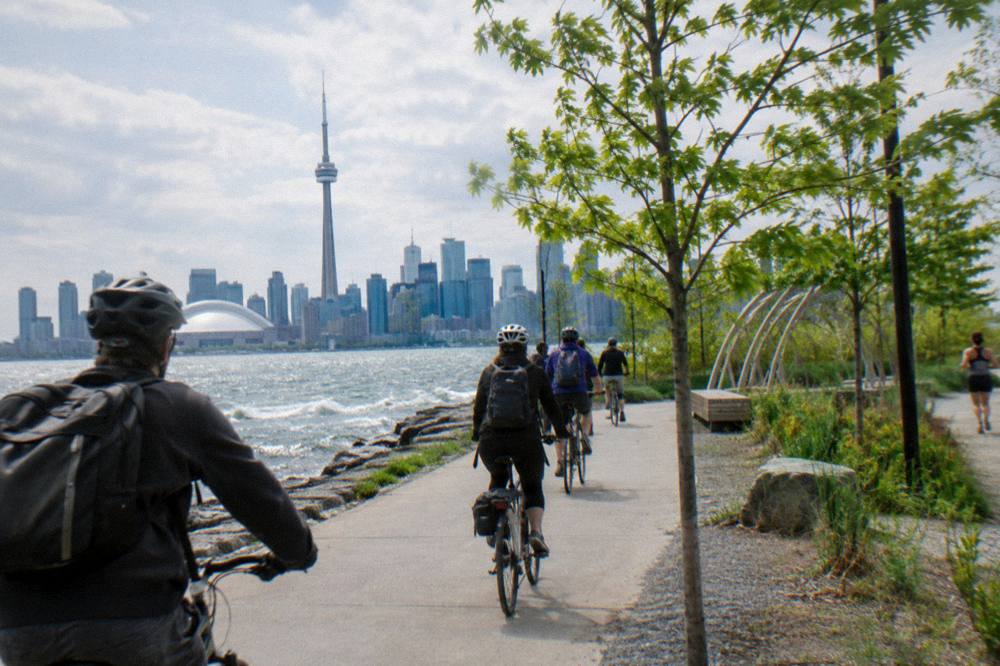
The evidence is in the street network itself. Toronto's cycling network as of December 2025 counted 346 km of on-street bikeways, including 110.1 km of cycle tracks and 143.8 km of bicycle lanes, plus 399.3 km of multi-use trails, according to the City's own network status page. The Martin Goodman Trail alone stitches together more than 20 km of waterfront from the western to the eastern beaches. That is a car-free city in miniature, and it touches nearly everything a first-time visitor wants to see.
The same logic applies to the Islands. Only emergency and commercial vehicles operate there, bicycles are welcome on the ferry, and Bike Share stations wait on the island side, though mainland Bike Share bikes themselves are not permitted on the ferries. A car cannot follow you across the water at all, which settles the question for one of the city's headline attractions before you have even packed.
There is a planning payoff too. Distances that look far apart on a map, like the Distillery District to the ferry terminal, or Kensington Market to the waterfront, compress quickly once you are on a bike rather than walking or circling for parking. The table below maps the main car-free options against what each is genuinely good at. Once you've settled on two wheels, our guide to free things you can reach by bike in Toronto covers the waterfront trails, free markets, and summer concerts that make a car-free day out cost almost nothing.
| Mode | Best for | Watch out for |
|---|---|---|
| Walking | Downtown core, Kensington Market, St. Lawrence Market, Distillery District | Distances add up fast west of downtown |
| Bicycle | The waterfront trail, the Islands, neighbourhood-to-neighbourhood travel | Helmet law for riders under 18 |
| Island ferry | Reaching Toronto Island Park | Winter schedule serves Ward's Island only |
| Bike Share | Short one-way hops between docks | Day pass covers classic bikes, e-bikes cost extra |
| Guided ride | Seeing the waterfront and Islands in one block of time | Fixed departure times |
| TTC transit | Long cross-city trips and rainy days | Check the operator for fares and routes |
For a deeper comparison of the shared-bike option against a tour with a guide, our bike share or guided ride comparison works through the trade-offs in detail.
How Does Toronto Transit Work For Visitors Without A Car?
Transit is the fallback for trips too long to walk or ride, not the backbone of a visitor's day. The City's own reporting on the 2026 World Cup period counted about 85,000 TTC riders on routes serving the venues over six match days and nearly 160,000 passengers through Exhibition GO Station, which tells you the system absorbs major crowds well. Fares, routes and frequency should be checked with the operator directly.
Those World Cup figures come from the City of Toronto's official impact summary, and they are the strongest available evidence of what the system handles at its busiest: a tournament that drew roughly 250,000 fans to six matches at Toronto Stadium pushed pedestrian volumes up 70 to 160 percent and cycling activity up 25 to 140 percent above baseline on match days, and transit carried the overflow. A normal visitor day is far lighter than that.
What cannot be printed here is a fare table. TTC, GO and UP Express fares, routes, frequencies and bicycle-on-transit rules are not among the verified facts for this guide, so treat the operators' own sites as the source of truth before you commit to a transit-heavy plan. The honest summary: transit in Toronto works, it is the right call for a rainy November day or a trip out to a far-flung neighbourhood, and it is rarely the best way to see the waterfront itself.
That last point matters for planning. The shoreline is linear, and the things along it, the Music Garden, Harbourfront, the ferry terminal, the Distillery District to the east, sit in a row that transit serves sideways. A bicycle turns that row into a single continuous ride. These three guided options each cover a different slice of that geography, with bikes, guides and snacks handled for you.
Each of those rides is 3.5 hours, shared-group format, and replaces what would otherwise be a day of hop-on hop-off decisions. The downtown ride in particular is the one most visitors use as their car-free anchor: the listing describes snacks included and a route through the core's neighbourhoods, and you can read the full breakdown on the Heart of Downtown Ride page.
Where Does A Bike Fit Into A Car-Free Toronto Day?
Almost everywhere. The cycling network's 346 km of on-street bikeways and 399.3 km of multi-use trails as of December 2025 mean a visitor can ride from the Beaches in the east to the Humber in the west almost entirely off traffic lanes, and the Islands extend that by car-free ferry. Ontario's rules are simple for visitors: helmets are mandatory only for riders under 18, and riding on sidewalks is not allowed.
The network numbers deserve a closer look because they explain why cycling feels different here than in many North American cities of similar size. Cycle tracks, physically separated from traffic, accounted for 110.1 km of the on-street total as of December 2025, and the multi-use trail network is larger than the on-street one. For a visitor, the practical reading is that the waterfront and the major valley corridors are rideable without mixing with fast car traffic, while some downtown streets still require attention.

Two legal notes from Ontario's official pages are worth carrying. By law, cyclists under 18 must wear an approved bicycle helmet, and required equipment includes a bell or horn, a white front light and a red rear light or reflector at night, per the province's bicycle safety page. E-bike riders must be 16 or older, wear a helmet, and stay within a 32 km/h assisted speed and 500 watt motor limit. Our full Toronto cycling rules and e-bike law guide covers the details.
One 2026 infrastructure note belongs in any honest car-free briefing. The Martin Goodman Trail on Parliament Street, between Merchant's Wharf and Lake Shore Blvd East, is closed from 22 April to 31 December 2026, with a temporary two-way protected bicycle lane carrying riders through the Quayside construction zone. It is a signed detour, not a break in the route, but it changes the feel of that short stretch.
Should you bring your own pedal power or let someone else arrange it? The question breaks down by confidence and by how much of the city you want to compress into one outing.
A guided downtown ride answers the confidence question directly: the operator supplies the bike, the route and the snacks, and the listing describes a 3.5-hour shared loop through the core. For riders who prefer their own pace with a rented bike, our renting a bike in Toronto guide covers pickup points and what to ask about.
How Do You Get To The Toronto Islands Without A Car?
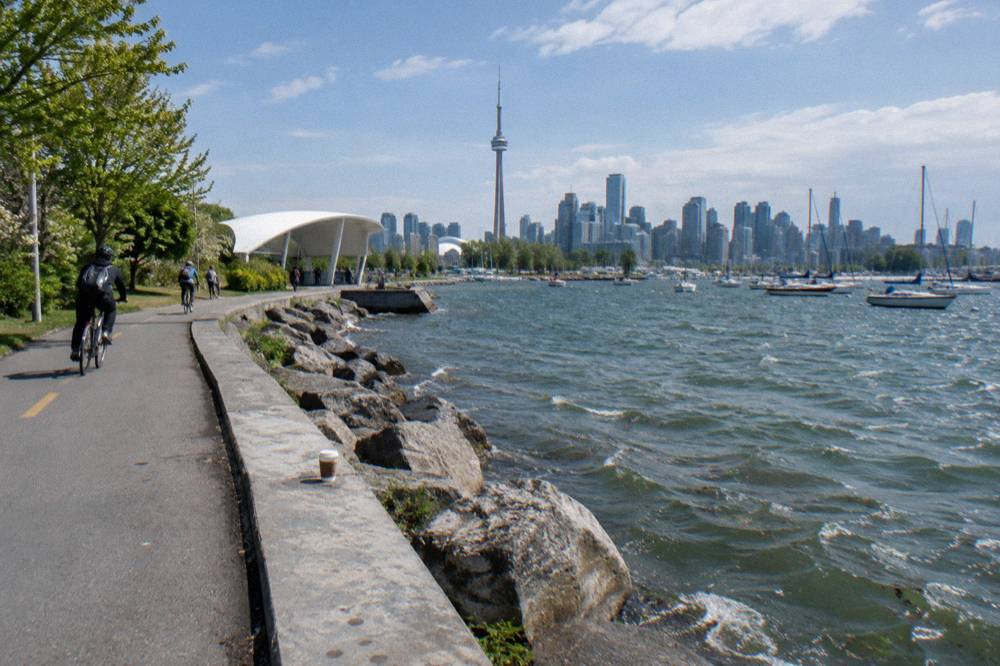
You take the ferry from the Jack Layton Ferry Terminal, and you pay for it: this is the one part of a car-free Toronto day that is not free. Round-trip fares in Canadian dollars are $9.57 for adults, $6.15 for older adults and youth, $4.51 for juniors and free for infants under two. Bicycles are welcome aboard, walked on and off; Bike Share bikes are not.
The fare table comes straight from the City's official ferry ticket page, and it rewards a little family math. The fare schedule scales gently by age, juniors pay less than half the adult fare, and the bike rides along at no charge, so a family crossing costs a fraction of a single downtown parking stub on a summer Saturday. Monthly passes are sold only at the terminal, and online tickets stay valid to year-end.
| Passenger | Round-trip fare (Canadian dollars) |
|---|---|
| Adult (20 to 64) | $9.57 |
| Older adult (65 and over) | $6.15 |
| Youth (15 to 19) | $6.15 |
| Junior (2 to 14) | $4.51 |
| Infant (under 2) | Free |
| Bicycle | Welcome, walked on and off |
E-bikes are a special case on the water. The City's rules say e-bikes travel at the discretion of staff, must stay fully powered off onboard, cannot be charged on the ferry or at the terminal, and larger e-bikes, roughly 40 kilograms and over, may be directed to the vehicle ferry instead. If your guided ride uses e-bikes, the operator handles this; the two e-bike listings in the city's tour options are the ones to compare, and our e-bike or regular bike comparison walks through that choice.
Season shapes the crossing. Winter service from 14 October 2026 runs to Ward's Island only, with first departures around 6:30 a.m. from the city side and roughly 15-minute frequency, until mid-April 2027. Spring and fall bring reduced three-route service, and full service to Centre Island and Hanlan's Point returns mid-May to mid-September. The City's sailing schedule page is the place to confirm your date before you roll to the terminal, and our Toronto Island ferry with a bike guide covers the bike-specific details.
The classic way to combine the crossing with the riding is a guided Islands loop, where the ferry logistics and the route are part of what you book.
That 3.5-hour waterfront and Islands ride is the one to look at if the crossing feels like friction you would rather outsource. Its sibling, the morning or twilight Islands ride, covers the same geography at the day's edges; both are described in our sunrise, morning and twilight rides guide.
Can You Walk Most Of Downtown Toronto Instead?
Yes, the core is genuinely walkable, and several of the city's best districts are at their best on foot. Kensington Market, St. Lawrence Market, the Distillery District and the waterfront between them occupy a corridor you can cross in under an hour of walking, and car-free events like Kensington's Pedestrian Sundays, the last Sunday of each month from May to October, close streets to traffic entirely.
The walking city has a rhythm worth knowing. Kensington's Flea Market runs Saturdays and Sundays from May to September, 11 a.m. to 7 p.m. at 216 Augusta Ave, free to wander. Pedestrian Sundays go further, making the market car-free from noon to 7 p.m. on the last Sunday of each month through the warm season. St. Lawrence Market's South Market keeps regular hours Tuesday through Sunday, closed Mondays, and its free Winter Market on Market Street runs 19 November to 22 December 2026.
Winter does not shut the walkable city down, it reorganizes it. The Distillery Winter Village runs 12 November 2026 to 3 January 2027, with the tree lighting on 12 November at 6 p.m., free entry Monday to Wednesday through 13 December and timed tickets after 4 p.m. on peak days, general admission from around $16. Evergreen Brick Works runs its pay-what-you-can Winter Market on four Sundays: 29 November and 6, 13 and 20 December 2026, suggested $5 per person.
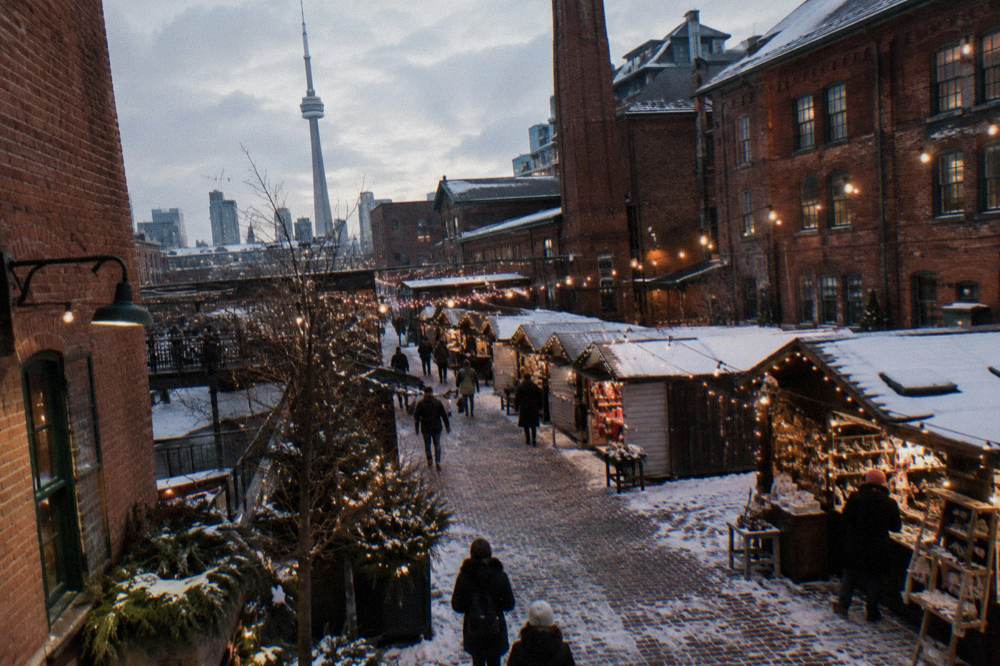
The honest limit of walking is distance, not charm. The gaps between the walkable districts, Kensington to the Distillery, the Distillery to the ferry terminal, are short enough to ride in minutes but long enough to tire you out twice in a day. That is the exact seam where a bicycle, your own or a guide's, earns its place, and it is why the car-free visitor's day usually ends up a hybrid: walking inside districts, riding between them.
For the district-to-district stitching, the downtown guided ride is the strongest fit, and check availability beside the full ride description before you commit to a date. Our Kensington Market and downtown neighbourhoods guide maps the same territory for self-guided riders.
| Free or cheap stop | When | Cost |
|---|---|---|
| Kensington Flea Market | Saturdays and Sundays, May to September 2026, 11 a.m. to 7 p.m. | Free |
| Kensington Pedestrian Sundays | Last Sunday monthly, May to October, noon to 7 p.m. | Free |
| Toronto Music Garden concerts | Thursdays 7 p.m. and Sundays 4 p.m., 21 June to 27 August 2026 | Free |
| Evergreen Winter Market | Four Sundays, 29 November to 20 December 2026 | Pay what you can |
| St. Lawrence Winter Market | 19 November to 22 December 2026 | Free |
| Distillery Winter Village | 12 November 2026 to 3 January 2027 | Free off-peak, tickets from about $16 at peak |
The full list of rides-and-markets pairings lives in our free things to do in Toronto by bike guide, which doubles as a car-free itinerary on its own.
Is Bike Share A Good Option For Car-Free Visitors?
It can be, for short one-way hops between docks. Reported figures for 2026 put Bike Share Toronto at roughly 10,000 bikes across more than 1,000 stations, with a $15 day pass covering unlimited 90-minute classic-bike rides, though e-bikes cost extra at a pay-as-you-go rate. These are reported figures, not confirmed on the operator's own site, so verify pricing at the Bike Share Toronto page before relying on it.
The nuance is the classic-versus-e-bike split. The reported pricing has the day pass covering classic bikes only, with e-bikes billed at an unlock-plus-per-minute rate even for pass holders. A rider planning several hops along the waterfront in one day gets real value from the pass; a rider counting on e-bike assist the whole way does not, and for that rider a guided e-bike ride or a rental with a flat rate makes more sense.
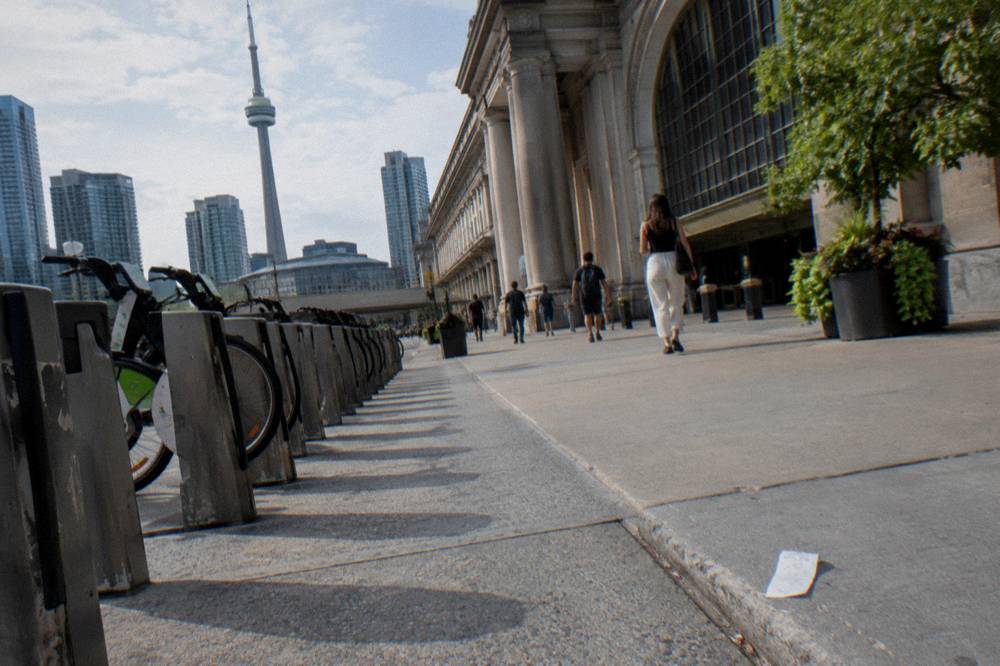
There are two hard rules to carry regardless of pricing. Bike Share bicycles are not permitted on the ferries, so a dock-to-dock island plan does not work; the Islands have their own Bike Share presence and a rental operator instead. And bikes belong on the road or the trail, not the sidewalk, with only children under 10 allowed on sidewalks under Ontario rules. Beyond that, our Bike Share or guided ride comparison is the detailed decision guide.
Bike Share's real strength in a car-free itinerary is one-way convenience: ride from the Entertainment District to the Distillery, dock the bike, walk the village, then walk or ride onward. Its weakness is the same as any dock system at peak times, availability near major attractions on a busy summer afternoon. A guided ride has no such uncertainty, since the operator brings the fleet to the meeting point.
When Does A Guided Ride Replace A Taxi Day?
When you want the waterfront and the Islands covered in one block of time, with the bike, the route and the timing arranged for you. The guided options all run about 3.5 hours in shared groups, versus a taxi day that bills by the trip and still leaves you parking, routing and missing the trail-only stretches. For a visitor with two or three days in the city, one guided ride plus independent walking covers nearly everything.
The comparison is not really price against price, since taxi costs vary wildly by time of day and traffic, and no verified taxi figures belong in this guide. It is structure against freedom. A guided ride trades spontaneity for compression: in the time a taxi day gives you three or four stops with parking in between, the 3.5-hour rides take in the downtown neighbourhoods or the shoreline as one continuous moving visit, with a guide narrating and snacks included on the listings that flag them.
The sunrise version of the Islands ride makes the point sharply. The listing describes a 3.5-hour morning ride with breakfast included, one of the few ways to be on the Islands early without owning a bike downtown or solving the ferry schedule yourself. Its review pool is small, so judge it by the itinerary rather than a rating.
The morning-or-twilight Islands ride is the same idea at more sociable hours, and the downtown and waterfront rides cover the mainland equivalents. Families weighing the decision can start from our which guided ride should you book guide, and winter visitors should read the seasonal notes in the best time of year to cycle in Toronto before booking anything.
Weather belongs in every car-free plan, and Toronto's normals argue for late spring through early fall. July averages a high of 27.0 C against a low of 18.1 C with about 76.5 mm of rain, while November, the month this guide is written in, averages a high of 8.1 C and 70.8 mm of precipitation across roughly nine days with a millimetre or more. October's mean high of 14.6 C still supports riding; January's minus 0.3 C argues for transit and the indoor markets. Bike Tours Toronto keeps seasonal notes on every ride page for exactly this reason.
For a final shortlist, these three rides cover the three geometries a car-free visitor cares about: the downtown core, the waterfront-and-Islands combination, and the Islands alone at the edges of the day.
Common Questions About Getting Around Toronto Without A Car
Do You Really Need A Car In Toronto?
No. The downtown core, the waterfront trail and the Toronto Islands cover most visitor itineraries on foot, by bike and by ferry, and the Islands ban private vehicles entirely. Transit fills the longer gaps, and fares and routes should be confirmed with the operator.
How Much Is The Ferry To The Toronto Islands?
Round-trip fares in Canadian dollars are $9.57 for adults, $6.15 for older adults and youth, $4.51 for juniors and free for infants under two. Bicycles ride along at no charge, walked on and off; Bike Share bikes are not permitted on the ferries.
Can You Take A Bike On The Toronto Island Ferry?
Yes. Bicycles are welcome on board, and you walk them when boarding and disembarking. E-bikes travel at staff discretion, must be powered off on board, and larger e-bikes of roughly 40 kilograms or more may be directed to the vehicle ferry.
Is Toronto Walkable For Visitors?
The core districts are very walkable: Kensington Market, St. Lawrence Market, the Distillery District and the waterfront form a corridor you can cross on foot in under an hour. Kensington's Pedestrian Sundays close the market streets to cars on the last Sunday of each month from May to October.
Is Bike Share Toronto Worth It For Tourists?
For short one-way hops, yes. Reported 2026 pricing puts a $15 day pass at unlimited 90-minute classic-bike rides, with e-bikes billed extra at a pay-as-you-go rate. These are reported figures, so confirm current pricing on the Bike Share Toronto site.
What Is The Best Car-Free Way To See The Toronto Waterfront?
Ride the Martin Goodman Trail, which runs more than 20 km along the shoreline from the western to the eastern beaches, or book a 3.5-hour guided waterfront ride that folds in the Islands and the downtown stretch with a guide, bike and snacks arranged.